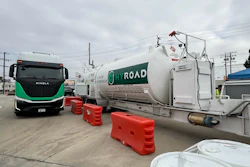














There's been plenty of news over the past year about electrified commercial trucking, good and bad, but it's important not to ignore other technologies capable of reducing GHG emissions that are affordable and readily available.
Optimus Technologies is one such company offering an alternative to electrification and even Renewable Natural Gas (RNG) and Compress Natural Gas (CNG) fuel systems. In this case, that alternative is biodiesel, also commonly called B99 and B100 (depending on the petroleum diesel blend).
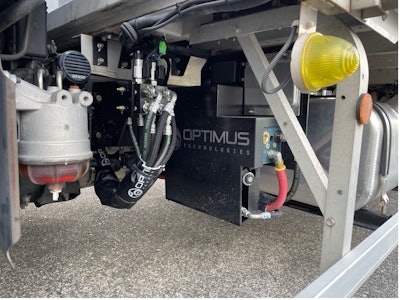
Optimus builds a bolt-on fuel system that upgrades a heavy-duty diesel engine to run on 100% biodiesel. Installing the system does not void OEM warranties, CEO Colin Huwyler previously told Clean Trucking.
Earlier this week, the Pittsburgh, Pa.-based company announced the signing of a Memorandum of Understanding (MOU) with Mitsui & Co., Ltd., a trading and investment company from Tokyo.
Through this agreement, Mitsui will serve as the sole distributor of Optimus' in-house-developed Vector System and companion products in Japan, India, and ASEAN countries.
By strengthening their existing partnership, the companies are doubling down on practical decarbonization. With electrification and hydrogen adoption still evolving (and in, some cases, failing outright), the expanded alliance enables Optimus and Mitsui to deliver near-term, scalable carbon-reduction solutions to fleets throughout Asia.
"This MOU represents more than just regional expansion—it's a strategic alignment," said Colin Huwyler, CEO of Optimus Technologies. "Mitsui's global reach, deep market expertise, and longstanding commitment to sustainability create an unparalleled opportunity to accelerate deployment of our technology in some of the world's most dynamic and fast-growing economies."
Optimus further points out that biodiesel offers multiple performance advantages, including no need for fuel additives and improved engine lubricity. It also reduces particulate buildup in both the engine and aftertreatment system and delivers a significantly higher cetane rating than petroleum diesel. Even in harsh winter conditions, vehicles have shown no issues with performance, idling, or cold starts.
According to the 2025 State of Sustainability Fleets 2025 Market Brief, "Nationally, [biodiesel] prices declined about 10% to $3.68/DGE on average (B99/B100) compared with $2.78 per gallon of conventional diesel, [which is] relatively on par with conventional diesel prices."