













A new hydrogen truck pilot at Port Newark will put zero-emission freight technology to the test in one of the region's busiest ports.
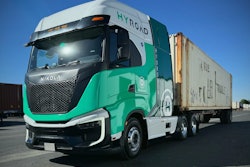
Led by Rutgers University's Center for Advanced Infrastructure and Transportation (CAIT), the $13 million initiative was recently awarded by the New Jersey Economic Development Authority and will deploy six Class 8 Hyundai XCIENT hydrogen fuel cell trucks for real-world drayage operations. The trucks will haul shipping containers in and around the port, providing a proving ground for hydrogen-powered freight in daily commercial service.
[Related: Translead will be distributor of Hyundai’s fuel cell trucks]
The yearlong demonstration is intended to assess how fuel cell electric trucks perform under the demands of port drayage, from vehicle reliability and fueling logistics to maintenance needs and overall operational fit. Rutgers CAIT will oversee project management, research, data analysis, and workforce development activities.
Hyundai Motor Company, for its part, will supply the trucks, while the Public Service Enterprise Group will support the hydrogen fueling infrastructure. Additional partners include the Center for Transportation and the Environment, which will assist with data collection and evaluation, and the Port Authority of New York and New Jersey, which will host the pilot at Port Newark.
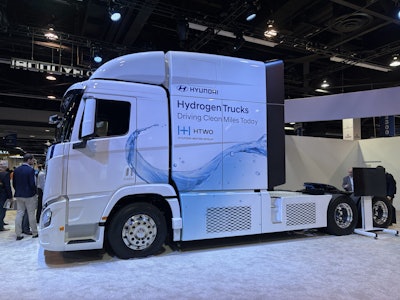
 The Hyundai XCIENT's e:fuel cell system on display.Clean Trucking
"This pilot is another step in the Port Authority's broader effort to look at every viable pathway toward a cleaner future for our critical infrastructure and operations," said Christopher Diamond, Director of the Office of Sustainability at the Port Authority of New York and New Jersey. "Our ambitious commitment to reaching net-zero carbon emissions by 2050 brings with it a responsibility to help chart the course toward greater sustainability across our vast network, including the East Coast's busiest seaport. We're eager to take advantage of the region's innovative spirit to examine emerging technology and accelerate the transition to a more sustainable future."
[Related: DOE cancels billions in green hydrogen production projects, future of FCEVs uncertain]
Project rollout will begin with vehicle acquisition, fueling planning, and site preparation, followed by truck deployment and on-road testing expected to start sometime early this year. Testing is scheduled to continue for approximately 12 months.
Data gathered during the pilot will help policymakers, fleet operators, and researchers better understand both the benefits and limitations of hydrogen fuel cell trucks in freight applications. Rutgers CAIT said the effort aligns with New Jersey's clean energy objectives while advancing research into scalable zero-emission freight solutions.
[Related: FCEV early adopter's operational concerns come to life]