













What you need to know:
- Port Power's solar-powered 'Depot in a Box' enables fleets like Family Laundry to electrify by reducing dependency on the local utility, instead using on-site solar and battery storage.
- The Oakland facility now supports 17 fully electric delivery vans, showcasing a scalable, low-cost charging model for small and medium-sized businesses.
- Family Laundry expects major cost savings, reducing per-mile expenses from 40 cents to as low as 5 cents per mile with the new charging infrastructure.
- City officials say the project advances Oakland's Equitable Climate Action Plan, proving how solar microgrids and managed charging can accelerate equitable fleet electrification.
Fleets of all sizes remain hesitant to electrify, largely because the process itself can feel overwhelming. Transitioning from diesel requires far more than purchasing battery-electric trucks—it demands new infrastructure, coordination with utilities, and long-term planning around energy needs.
Silicon Valley–based Port Power believes it has a simpler path forward.
A $1 million solar-powered charging hub
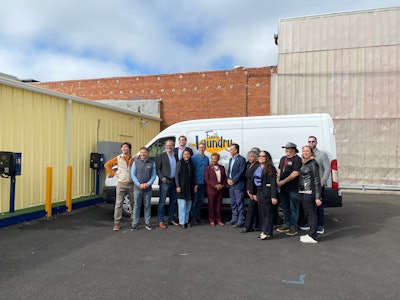
Last month, Oakland's Family Laundry—a family-owned business launched in 2018—completed a $1 million installation of Port Power's solar panels, battery storage, and integrated EV charging system at its San Antonio neighborhood facility. The project was supported by the Bay Area Air District, Pacific Community Ventures, the LA Cleantech Incubator, and funds and a power upgrade from PG&E.
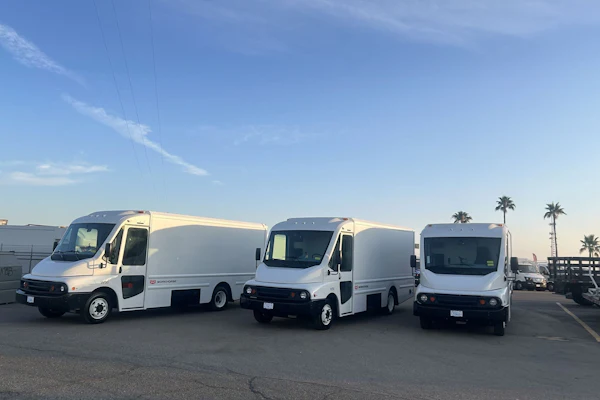
The site, shared with Community Kitchens' all-electric refrigerated delivery van, can now charge up to 17 electric last-mile vans entirely with solar power. Importantly, the charging depot reduces dependency on the local utility provider.
Speaking to Clean Trucking, Port Power Founder and CEO Nadav Gur explained that his company has created "a telematic platform for highly efficient fleet charging sites and depots. This kind of electrical infrastructure behaves differently from traditional building infrastructure: it must deliver high power when vehicles are present, but once they leave, the system sits unused. Our view is that you don't need that model; instead, you need smart energy and power management."
An alternative to traditional depot design
Typical BEV fleets rely on numerous large, stationary chargers—often high-power megawatt units—installed across a dedicated depot. Port Power upends that model by focusing on making electrification easier and cheaper for small- and medium-sized operations.
[Related: Megawatt charging explained: What it is and why it matters]
"Our aim is to make the infrastructure cheaper. We believe that there should be a charger in every parking spot. In most projects, there are not enough chargers because the installers assume all of the chargers are operating at full speed, all the time, which they never are really. When we have chargers for every spot, it allows us to move the electrons around instead of moving the vehicles around. The vehicles get the power regardless of where they're parked."
This moving process is called 'oversubscription,' where an energy management system enables more total power than the sum of the theoretical power of all the chargers, because it caps that sum.
"We're enabling small and medium-sized companies to come in and deploy their vehicles. Family Laundry owns everything. We helped them get the permits, etc. We enable all of that to work optimally, deployed quickly. In cases where you need outside funding we also have partners," said Gur.
Inside the 'Depot in a Box'
Family Laundry is now running Port Power’s modular “Depot in a Box,” a pre-integrated system that packages charging hardware, energy-management software, and site automation for rapid deployment.
The setup includes 17 charging ports, all supported by on-site solar generation and battery storage. With microgrid capabilities, the system stores solar energy collected during the day and uses it to charge delivery vans overnight. Gur says this model protects businesses from rising energy costs while ensuring reliable charging access.
"You can put in as many chargers as you want, but just make sure you have enough power. We do managed charging—looking at what you have and sending the right amount of power to each vehicle in real time," said Gur. "For example, one vehicle will charge faster because it's leaving sooner. What's misunderstood is that the best way to optimize is also to control the electricity, or at least monitor the electricity in the facility. This allows you to add solar, battery storage, and even generators so that you have cheaper and more resilient solutions. By adding solar and batteries, you can increase your power and make everything cheaper."
Telematics play a critical role.
 A screenshot showing how Port Power's proprietary telematics technology details charging sessions and charging management.Port Power/Clean Trucking
"Telematics detail charging sessions and charging management. It can make sure to charge during off-peak hours when electricity is less expensive. If you have batteries, then you shift the electricity you collect from solar during the day so it can be used to charge vehicles at night."
Electrification delivers immediate cost savings
Family Laundry estimates that electrifying its fleet will cut its ecological footprint by roughly 8 metric tons of CO2 per vehicle each year.
The operating cost benefits are even more striking. The company’s cost per mile has dropped from roughly 40 cents before electrification to 25 cents with standard EV charging—and will fall to just 5 cents per mile once the new depot is fully optimized. That equates to about $10,000 in annual savings per vehicle, plus thousands more in reduced maintenance costs.
 Family Laundry co-owner David Macquart-Moulin charges one of the company’s all-electric Ford E-Transit vans.Port Power
"Going electric it makes financial sense, otherwise we wouldn't do it. We are saving drastic amounts of a lot of money now," stated Family Laundry co-owner David Macquart-Moulin.
A model for Oakland's climate and equity goals
City officials say the project aligns directly with Oakland’s Equitable Climate Action Plan and Zero Emission Vehicle Action Plan, both of which aim to reduce emissions while ensuring climate investments reach frontline communities.
"This project represents the kind of innovative partnership Oakland needs to meet our climate goals. I want to thank Family Laundry and Port Power for making it a reality, particularly the decision to extend charging access to Community Kitchens," stated Oakland Mayor Barbara Lee. "This project proves that when Oakland's businesses, nonprofits, and public agencies work together, a just transition to a green and equitable economy isn't merely aspirational—it's within reach."
Scaling the model across fleets and cities
Gur notes that Port Power is expanding its work with businesses that own onsite fleets as well as those offering charging access to others—similar to the Family Laundry and Community Kitchens partnership.
"At end of the day, we're the brains of the system to ensure it operates optimally. We can collaborate with different kinds of players to adopt to their business model," Gur concludes.
He also argues that municipal fleets are one of the biggest untapped opportunities for electrification.
"Municipal sites always engage with old electrical contractors and they always get the wrong answers. And we come in and say we can charge 200 vehicles here at the same time, no problem. You just don't need those five fast chargers but get like 20 slower chargers. Municipal fleets are such an opportunity for electrification. There are so many light- and medium-duty vehicles that are so easy to electrify. Government organizations also don't know the technology very well. They create these grant programs but make hurdles and think they're doing good but they're not. There's no vehicle in the market that can take that speed and have no need for that much power at once. There's simply a lack of understanding on their part."