













What you need to know:
- ABB E-mobility unveils the M-Series EV charging platform, signaling a shift toward profitable EV infrastructure focused on delivered energy and site economics
- The modular split-system charger enables scalable EV charging (up to 1.2 MW) with dynamic power distribution and flexible site design
- Shared power architecture boosts charging efficiency, lowers cost per kWh, and improves real-time load management
- Built for fast-charging, retail locations, and fleet depots, it supports incremental scaling and reduced TCO
ABB-e Mobility is back in the spotlight just ahead of this year's ACT Expo in Las Vegas as the public charging sector matures from rapid buildout to real infrastructure operations. In short, success is no longer measured by how many plugs are installed at any given site, but rather by how much energy actually flows and how profitably those sites perform.
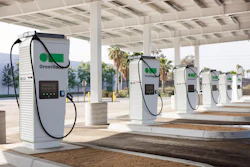
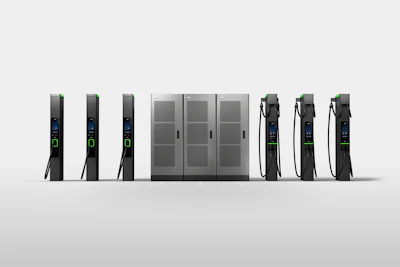
As such, ABB E-mobility has introduced its new M-Series platform, a modular, air-cooled split system that decouples power units from dispensers. The design allows operators to tailor charging configurations to specific duty cycles and site demands, rather than relying on one-size-fits-all hardware deployments.
[Related: ABB E-mobility's megawatt charging system previews the future of trucking]
How the M-Series works
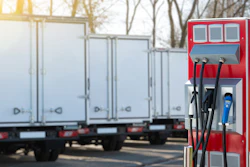
With the M-Series, which scales from 200 kW to 1.2 MW and supports up to 24 charge points, power is no longer locked to individual charge points. Centralized power cabinets feed a range of ChargePost dispensers—Solo, Duo, Dock, and Ultra—supporting CCS1, CCS2, NACS, and MCS across 36 possible site configurations.
[Related: MAN, ABB E‑mobility complete major Megawatt Charging System test]
By separating power from the plug, ABB says operators can design sites around specific use cases, aligning infrastructure with different customer segments, utilization patterns, dwell times, and revenue models.
At its heart, the M-Series takes a different approach to power delivery. Instead of sizing infrastructure for peak demand at every stall, the system treats installed power as a shared, managed resource by distributing capacity across charge points based on real-time demand.
The result means less overbuilt capacity, sustained high power delivery under load, and a lower cost per kilowatt-hour, improving both site economics and overall operational efficiency.
Delivering 625 kW per square meter (that's 1.2 MW in under 2 square meters), the system packs more power into less space, improving site economics where land is tight or expensive. The bottom line is that delivered power—not nameplate capacity—is what matters.
You see, EVs pull energy differently, and conventional systems lose output in the transfer. The M-Series keeps delivered power close to rated levels across vehicle types, ensuring more of the installed capacity actually reaches the battery.
Designed for three core site types
The M-Series is designed around three core site types, each with distinct operational and economic demands:
Public fast-charging corridors: Sites scale from a single 400 kW cabinet to 1.2 MW and up to 24 charge points in 400 kW increments—without redesign. Each expansion builds on existing assets, allowing operators to invest as demand materializes, not ahead of it.
Retail and hospitality: At supermarkets, fuel stations, and logistics hubs, the system balances between high-power sessions and parallel charging as utilization shifts. Integrated branding, advertising, and commerce features are built in, while existing infrastructure continues generating value as sites grow.
Commercial fleet depots: For mixed fleets of vans, trucks, and buses, the platform enables stepwise expansion in 400 kW increments, aligning costs with real fleet adoption. It supports both high-power opportunity charging and lower-power overnight charging on the same system—eliminating the need for separate infrastructure and reducing financial risk.
M-Series vs. A-Series
The M-Series builds on ABB E-mobility's existing A-Series platform. While the A-Series delivers a proven all-in-one system for straightforward deployment and consistent high-power performance, the M-Series moves to a split-system design—decoupling power from dispensers to enable configuration by use case, not default hardware.
ABB confirms that both platforms share the same air-cooled, in-house silicon carbide power electronics and common reference architecture.
"The industry spent a decade optimizing for nameplate power. What operators need to optimize for now is the cost of energy delivered over the lifetime of a site," said Michael Halbherr, CEO of ABB E-mobility. "Power only matters if it can be consistently delivered—across vehicle architectures, across charge points, and across utilization levels. The M-Series is built to optimize that."