













What you need to know:
- EV Realty is making fleet electrification easier with Charging-as-a-Service (Caas), megawatt charging infrastructure, and scalable EV charging solutions built for Class 8 electric trucks and busy freight and logistics hubs
- Their hubs are designed so fleets can actually keep moving—thanks to Megawatt Charging System, CCS compatibility, simultaneous fleet charging, real-time power sharing, and traffic flow optimization that cuts down logistics bottlenecks
- They also help fleets control costs with smart energy management systems, including load balancing, demand charge mitigation, and overall operational efficiency
- On top of that, everything is built as turnkey EV charging hubs, offering fleet operations support, secure truck parking, overnight charging, en-route fast charging, and true end-to-end infrastructure solutions
As heavy-duty fleets continue their pivot to electrification, operators face a stark reality: public chargers and retrofitted facilities simply aren't enough. Often times, these essentials don't exist.
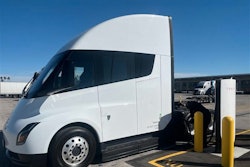
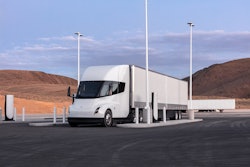
Heavy-duty, Class 8 battery-electric trucks like the Tesla Semi, Volvo VNR Electric, and the Freightliner eCascadia need megawatt-ready infrastructure, operational efficiency, and flexibility—all at scale.
That's exactly what San Francisco-based EV Realty is building.
Speaking to Clean Trucking, the Charging-as-a-Service (CaaS) company's Chief Commercial Officer, Suncheth Bhat, explained that "EV Realty has the space, power, and operational support to empower any electric fleet. Our sites are strategically located to serve key freight and logistics hubs where access to charging is needed and where power is often constrained."
With a combination of Megawatt Charging System (MCS) and CCS compatibility, its hubs are designed for a wide variety of medium- and heavy-duty EVs.
Megawatt charging included
Fleet operators often ask whether sites can handle multiple heavy-duty EVs at once. EV Realty confirms this is possible.
"Our sites are designed with access to power as a key consideration," said Bhat. "To date, we have not been in a situation where major utility upgrades are required. This includes our San Bernardino hub, which will open soon with 9 MW of grid power and no costly, time-consuming upgrades."
Each pull-through charging stall is powered by 1.2 MW of dedicated cabinets, allowing one truck to charge at full capacity or two trucks at 600 kW each. Bhat adds that "we can shift power between stalls in real-time," allowing multiple fleets to operate simultaneously without disruptions.
Future sites will follow a similar blueprint, tuned to local grid capacity and tenant feedback.
[Related: EV Realty lands Outpost investment, adds Stockton property]
High-throughput design
High-powered chargers mean little if yards get clogged with traffic or when schedules change. EV Realty's hubs avoid these issue because they are engineered for efficiency from gate to charger. "Our San Bernardino site can sustain high-throughput charging cycles from a power perspective,” Bhat says. "Scheduling and reservations allow us to prevent congestion and disruptions to delivery operations."
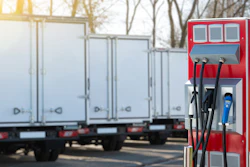
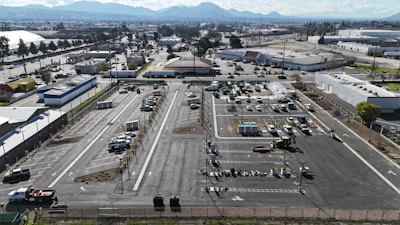
 A row of battery-electric commercial vehicle charging stations at EV Realty's San Bernardino, California hub.Marcharrisphotography
In other words, large lots, clear traffic flow, and software-enabled reservations allow fleets to stage, circulate, and queue without bottlenecks.
Concerns regarding technical assistance or other potential issues are legitimate but Bhat confirms "there will be on-site staff support to ensure smooth operations and address any unforeseen bottlenecks."
Energy management
Another key concern for fleets are peak demand charges when charging multiple heavy-duty EVs. At San Bernardino, those concerns are mitigated.
"There are no demand charges today for our San Bernardino hub. We are actively engaging with utilities and regulators to ensure that rates, inclusive of demand or subscription charges, facilitate transportation electrification," Bhat said.
Furthermore, load management provides operators flexibility to balance cost and operational efficiency. "We offer multiple power levels with load management to allow fleet operators to optimize their operations, balancing cost and time. Load management technologies also allow us to mitigate demand spikes across the site."
Turnkey hubs
EV Realty doesn't just provide chargers; it offers a full operational base for fleets. With parking, security, and office space, hubs can function as both a domicile and operational hub, complementing public truck-stop-style charging. "We provide a turnkey solution that can seamlessly integrate into fleet operations,” Bhat said. "Our sites are designed and sized to serve a wide variety of medium- and heavy-duty fleet types and use cases."
In short, whether it's a large regional haul fleet, a local delivery operation, or a municipal fleet, the company is capable of accommodating diverse needs with overnight or higher-speed, en-route charging.
Future expansion
For now, the Golden State is the initial launchpad for EV Realty, and for good reasons.
"Given the scale of California's economy and emphasis placed on the EV transition, there is still a ton of work to be done within the state,” explains Bhat. "Looking beyond the borders, regions with favorable energy markets and proximity to major transportation hubs make sense for replicating this model.”
[Related: 2025 was a tough year for commercial ZEVs, but the transition still moves forward in 2026 and beyond]
The company focuses not just on buying land, but also on the critical task of optimizing fleet operations.
"We partner with fleets to optimize their operations in a safe and secure location. We provide turnkey services that allow fleets to sidestep the complications of charger installation, operations, and maintenance. The goal is to provide an 'easy button' for fleets considering electrification."
With megawatt-ready hubs, high-throughput site design, and integrated energy management, Bhat says the company is addressing the biggest pain points for heavy-duty electric trucking. "Our goal is to provide a turnkey solution that empowers fleets to focus on operations—not charging logistics. This is the foundation for the next generation of freight."
As EV adoption accelerates across North America, operators will need more than chargers. They require sites designed for scale, flexibility, and operational resilience.
EV Realty says it's there and ready to go, megawatts ahead.