













Article Summary
Workhorse is protecting last-mile delivery fleets from fuel volatility by offering affordable electric step vans with 64% lower operating costs, a modular Gen 7 platform to achieve cost parity with gas trucks, and service-based partnerships that convert capital expenses into operational expenses for contractors.
- A typical FedEx route experienced approximately $10,000 in additional annual fuel costs when gas and diesel prices spiked to five to six dollars per gallon in 2026.
- Workhorse's electric step vans demonstrate roughly 64% lower operating costs compared to internal combustion engine trucks in real-world FedEx Ground operations.
- The company introduced a 140-kilowatt battery configuration alongside its 210-kilowatt version to serve price-sensitive contractors running routes under 100 miles daily.
- Workhorse's upcoming Gen 7 modular platform uses shared structural components across vehicle classes to reduce unit costs and achieve cost parity with gas trucks.
- Truck-and-charging-as-a-service partnerships convert capital expenses to operating expenses, allowing fleets to offset higher lease costs with weekly and monthly operational savings.
For years, fleet managers treated fuel costs as a predictable variable, penciled into multi-year financial models with sustainability goals rolled out on comfortable timelines. The severe gas and diesel price spike in the first half of 2026 shattered that complacency, turning fuel volatility from a line-item nuisance into an existential risk—especially for the independent contractors who run last-mile delivery routes on razor-thin margins.
"Most of us have never seen an industry become a multi-billion-dollar industry because government created it," said Scott Griffith, CEO of Workhorse, in an interview with Clean Trucking. "I don't think this one's going to do that either. I think we have to go head-to-head against ICE trucks."
That shift—from environmental idealism to hard-nosed risk management—is reshaping how Workhorse, following its merger with Motiv Electric Trucks late last year, designs, prices, and services its medium-duty electric trucks.
The $10,000 penalty
Workhorse traces the urgency directly to what happened on the ground this year. Through its Stables by Workhorse subsidiary, the company runs an active FedEx Ground independent service provider fleet—a real-world mix of internal combustion engine and battery-electric step vans that has already shown roughly 64% lower operating costs on the EV side. When gas and diesel prices spiked to five and six dollars a gallon this year, that gap widened fast.
"Probably the cost per truck of the gas price increase this year, if you're running a typical FedEx route on a truck, probably about $10,000 a year," Griffith said. "So if you're running 20 trucks, now all of a sudden you've got $20,000 of extra cost. For a lot of these independent contractors, that's pretty much the best-case profit margin for them a year, right? So you basically created the profits when you do that."
Griffith said the price swing "nearly went up by about the cost, the actual cash cost savings went up by 40% or 50% because of the increase in fuel prices"— turning the EV from a discretionary purchase into what he called a wake-up call for "an old risk factor that's new again."
The "Goldilocks" fleet strategy
Small, price-sensitive contractors can't absorb a big upfront premium, which is why Workhorse introduced a 140-kilowatt configuration of its W56 step van alongside the existing 210-kilowatt version. The lower-cost battery is aimed squarely at short, predictable routes—100 miles a day or less—the kind FedEx contractors typically run, while still preserving roughly 60% of the platform's operations-and-maintenance savings over ICE trucks.
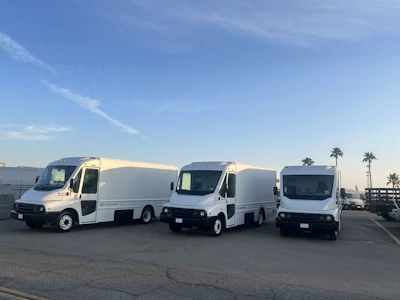
 A white Workhorse W56 step van parked at a FedEx facility.Workhorse
"What we're seeing is contractors starting to say, 'okay, I'm going to start to look at my fleet and parse up my routes,'" Griffith said. "We'll almost, you know, find the Goldilocks one for that truck and we'll run those routes. And the one that's just right for short routes, [typically] the 140 kW model, will go into that route."
Stripping out the premium
Griffith is blunt that voucher programs and state incentives won't carry the industry to scale on their own—cost parity with ICE trucks must come from the factory floor. That's the goal behind Workhorse's upcoming Gen 7 modular platform, which shares a common set of structural components across vehicle classes.
The platform "will have a unified set of components, batteries, brakes, suspension, and rails that can get bigger and smaller," Griffith said. "What we put on that will depend on cab versus step van versus configuration. But what that does is it's going to really reduce our unit costs on the supply chain and the engineering side because we have so much commonality through all classes that we're selling."
That commonality is expected to lower Workhorse's bill-of-materials costs— helped by a factory break-even point of roughly 2,500 trucks a year—and Griffith is watching an overseas precedent closely. "If you look at China right now, what really drove the knee in the curve there was when they got within about 20%, 15% of ICE truck pricing, things took off," he said.
Solving the CapEx wall
Even as sticker prices come down, installing charging infrastructure remains a hurdle for mid-sized fleets. That's driving growth in truck- and charging-as-a-service partnerships, including Workhorse's tie-ups with Gateway and Highland Fleets, which bundle the truck, the lease, the infrastructure and the electricity together.
[Related: Inside EV Realty's 9MW electric truck charging hub in San Bernardino]
"Those companies are combining leases, infrastructure, electricity, and the truck... and that bundle is making this much more affordable for some fleets, because what they're really looking at is changing from capital expenditure to an operating expense," Griffith said. Because operating savings are so significant, he added, "the money you're saving weekly, monthly, annually on operating and maintenance costs can be plowed back into a slightly higher lease price. And at the end, your cash through the life of the truck is the same."
Training technicians in-house
A nationwide shortage of certified high-voltage EV technicians has become a real bottleneck for dealership service bays. Workhorse's response runs through its Workhorse U training program and a network of internal experts who train dealer technicians directly—but the company is increasingly building programs for large fleets that want to bring maintenance in-house entirely, such as Purolator, whose Canadian medium-duty EV fleet is approaching 200 vehicles.
"What we're doing is starting to train the dealers and their technicians," Griffith said. "A lot of the large fleets really want to bring this maintenance internal. They may have a depot operation now, so they want to train their own technicians. And so we've developed a program to do just that with larger fleets."
A centralized, engineering-backed call center helps triage issues between dealers, in-house techs and Workhorse's own field engineers.
Riding the network redesign
Griffith also pointed to a structural shift underway at UPS, FedEx, and Amazon, which are redesigning their logistics networks around smaller, urban mini-warehouses rather than distant mega-hubs—a change he expects to favor medium-duty trucks over larger long-haul rigs.
[Related: Inside the small Colorado city with a fully electric garbage truck fleet]
"They are all going through major network redesign reconfigurations right now, and what we're seeing is that's going to increase the number of medium-duty trucks," Griffith said. "They're building more and more small, close-to-the-customer warehouses, if you will, and they're running either semis or medium duty between those two. I think things like that are where we're going to see more adoption of medium duty."
Those routes—repetitive, predictable, and depot-based—are exactly the profile electric trucks are built for. The fuel shocks of 2026 didn't create the shift toward electric last-mile delivery, but as Griffith tells it, they made clear that for fleets running on thin margins, the calculus has changed for good.