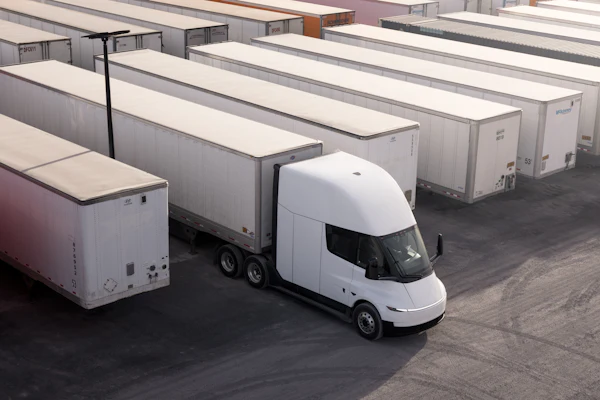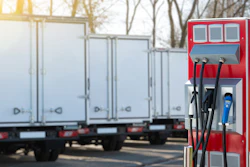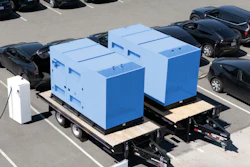













As more fleets transition to electric trucks, one challenge continues to stand out: charging. Building enough infrastructure to keep heavy-duty vehicles moving is no small task, especially in busy freight corridors where uptime is critical.
In our latest video, Clean Trucking tours EV Realty's new flagship charging hub in San Bernardino, California, located in the heart of the Inland Empire—one of the nation's busiest freight regions.
This 9-megawatt facility is designed to support more than 200 medium- and heavy-duty electric trucks per day. The site features a mix of high-powe megawatt charging systems, CCS1 fast chargers, and intelligent power management through Kempower charging cabinets, providing the flexibility needed to serve a wide range of commercial EVs.
To understand what it takes to build and operate a hub of this scale, Clean Trucking speaks with two leaders helping shape the future of zero-emission freight.
EV Realty Chief Commercial Officer Suncheth Bhat explains how the company secured 9MW of electrical capacity for the site and why shared, multi-tenant charging hubs can help fleets electrify without the cost and complexity of building their own infrastructure.
The conversation also includes Nevoya CEO and co-founder Sami Khan, who offers the fleet operator's perspective on running electric freight routes. Khan discusses how reliable, high-capacity charging infrastructure is helping electric trucks become increasingly competitive with diesel in both operating costs and day-to-day reliability.
Watch the full tour to see how large-scale charging hubs are addressing one of the biggest obstacles to fleet electrification and enabling the next generation of clean freight transportation.
00;00;00;03 - 00;00;12;04
Jay Traugott
I'm in San Bernardino, California at Evie Realty is massive new multi fleet charging hub. This is nine megawatts of grid capacity right here in the heart of one of California's busiest freight corridors.
00;00;12;07 - 00;00;18;27
Suncheth Bhat
You know, this may look like a big parking lot, but it isn't energized. It is an electric power. Power here. Yeah.
00;00;18;28 - 00;00;41;23
Jay Traugott
In this video, I'm going to go behind the scenes of the 76 port hub and talk to the Chief Commercial officer of EV Realty, as well as Navojoa CEO Sammy Cahn. Now is interesting because it's at AI powered all electric fleet that comes here every single day to this site that is designed to accommodate up to 200 heavy duty and medium duty battery electric trucks.
00;00;41;23 - 00;00;52;12
Jay Traugott
So stay tuned because there's a lot to unpack. And to learn more about alternative power in the freight industry, go to Clean Trucking. Com.
00;00;52;15 - 00;01;04;00
Jay Traugott
Thank you for for having me here today. Tell us more about the San Bernardino site. As I understand, you started building it only last September and it opened in April. So walk me through this a bit here.
00;01;04;01 - 00;01;30;02
Suncheth Bhat
Yeah. Thanks, Jay. Yeah, we're in San Bernardino, California, in the Inland Empire. This is our first powered property for ever. And I think it all starts with how we found this site. So this site we found with some of our proprietary software that analyzes grid information, truck density information, truck traffic information, and land use conditions. Okay. This area was particularly interesting because we saw a ton of truck traffic.
00;01;30;04 - 00;01;51;09
Suncheth Bhat
There's, you know, 3000 heavy duty trucks that are domiciled around this area. There are 18,000 trucks that pass by this area every single day. You know, we're only a quarter mile from the Interstate 215 and about two miles from the Interstate ten. And so this is really the central location where a lot of truck traffic, the heart of the empire.
00;01;51;11 - 00;02;01;05
Jay Traugott
And as we can hear, nothing but trucks on the road here. These are obviously a lot of diesels that we can hear, but the activity is here. So. And that's why you chose this.
00;02;01;06 - 00;02;12;01
Suncheth Bhat
That's why we chose this place. We've been fortunate enough to to build this site, materialize the site with 76 chargers, nine megawatts into one of the largest truck charging hubs in the in the United States.
00;02;12;03 - 00;02;13;08
Jay Traugott
Nine megawatts is a.
00;02;13;08 - 00;02;24;26
Jay Traugott
Lot of power, enough to power a few thousand homes. Securing that kind of capacity isn't always easy. I asked how they were able to procure this from their local utility, California Edison.
00;02;24;27 - 00;02;27;06
Jay Traugott
Walk me through that process with California Edison.
00;02;27;07 - 00;02;49;20
Suncheth Bhat
Yeah, Edison's been really good. One of the things that they do, I think, better than most other utilities across the entire country, is they have a lot of data that they make public about their grid and where there is power. Not all utilities do that. And Edison actually has a very, very good tool that they make public on their website that allows this data.
00;02;49;21 - 00;03;14;23
Suncheth Bhat
And this is incredibly important to start trying to build out these types of depots. And through that process, as we secured the power, worked with them on figuring out exactly where the power was going to come from. And when it came to interconnection, we were able to get the full nine megawatts that we had requested in sort of a rapid amount of time in comparison to a site that might have needed a lot of grid upgrades.
00;03;14;24 - 00;03;20;28
Suncheth Bhat
And that's one of our approaches to all of this, is trying to find where there are these pockets of large amounts of power.
00;03;21;01 - 00;03;33;25
Jay Traugott
What Sanchez gave me the backstory on the site. We took a walk around the facility to check out some of the technology behind it, including what are arguably some of the most powerful truck chargers in the world. Megawatt chargers.
00;03;33;27 - 00;03;40;14
Jay Traugott
All right. Sanchez. Right behind us is a Kemp Power megawatt charger. Now, why is this so critical for your operation here?
00;03;40;16 - 00;04;05;16
Suncheth Bhat
Yeah, we're excited about having this at our site. This is an mix. Megawatt charger can charge up to 1.2MW. But what's really exciting about this is the 1.2MW will be able to charge any truck on the mix standard. The Tesla Semi, of course, is coming out later this year and that is on an MKS standard. And so what the mix really enables is an ability to charge really quickly.
00;04;05;16 - 00;04;13;14
Suncheth Bhat
And so with this charger on a Tesla Semi you can get about 300 miles of range in approximately 30 minutes.
00;04;13;14 - 00;04;15;14
Jay Traugott
So how many of these megawatt chargers do you have at the.
00;04;15;15 - 00;04;29;09
Suncheth Bhat
So we have two of these megawatt chargers. We also have the site being future proofed to to be able to add more bike charging. Okay. And so we're excited about this. As the Tesla Semi gets on the road we'll be ready to charge.
00;04;29;10 - 00;04;30;19
Jay Traugott
Excellent.
00;04;30;21 - 00;04;48;18
Jay Traugott
Well the megawatt chargers here may eventually serve trucks like the Tesla Semi. Most of the charging taking place during my visit was happening at the site. CC one Chargers with several Freightliner Cascadia pulling in and out of the facility. We took a closer look at the charging system that makes up the majority of the hub.
00;04;48;19 - 00;04;57;08
Jay Traugott
Right now we are at the one Chargers. We are previously at the Megawatt Charger. Remind us the difference between megawatt charging and one charging.
00;04;57;09 - 00;05;15;13
Suncheth Bhat
Yeah. So at our site, as I mentioned, across the nine megawatts of power that we have, we have 76 chargers at the site. Four of those are what we call pull through. And those are really designed for trucks that are carrying a trailer. Really. That's for on route charging. Right. Like a truck is coming in. They've got a load.
00;05;15;14 - 00;05;40;04
Suncheth Bhat
They need to charge up real quick and get back out on the road. The remaining 72 chargers at this site are what we call pull installs or dedicated stalls. And those you can charge up to 400kW on those chargers. And what that really is is a dedicated stall for a particular customer. We contract with customers for this. Customers pay a monthly fee and then we pass the energy cost through at cost.
00;05;40;05 - 00;05;54;12
Suncheth Bhat
But what we're really trying to do is build out the infrastructure and then facilitate the access to the customer and allow the customer, the fleet, do what they do best, which is manage and optimize their cost and their schedule.
00;05;54;14 - 00;06;09;23
Suncheth Bhat
One other thing I think that is cool about a site like this is that this is designed for multiple fleets, and therefore the cost of that infrastructure can be brought down because the capital expenditures of the project are spread over more customers than just a single fleet.
00;06;09;24 - 00;06;10;24
Jay Traugott
I see.
00;06;10;27 - 00;06;22;21
Jay Traugott
The final piece of technology we looked at was the power cabinets. These are essentially the heart of the charging hub, intelligently managing how the sites nine megawatts of power are distributed across its chargers.
00;06;22;22 - 00;06;32;21
Jay Traugott
All right. So now here we are under some canopy and sun relief, which is obviously very nice for both of us. But these are power cabinets. And there are many ways like the heart and soul of this whole operation.
00;06;32;23 - 00;06;58;18
Suncheth Bhat
Yeah. So these are chem power power cabinets. The way the charging architecture that we have installed at this site is distributed charging. And so what that means is the power comes into these power cabinets in 600 kilowatt blocks. And then from this power cabinet we go out to six different dispensers. We layer on software on top of the hardware.
00;06;58;25 - 00;07;22;19
Suncheth Bhat
And what we can do is throttle different amounts of power to different dispensers, depending on how much power that particular fleet and that truck needs in that moment. So we can ingest fleet schedule data from a customer. And as an example, perhaps two of their trucks show up at the same time, and we know one of them needs to go fill up as quickly as possible and then hit the road like stat.
00;07;22;19 - 00;07;42;00
Suncheth Bhat
And then the other one could have a longer dwell time. And so what we can do with with that schedule, with that data is throttle more power to the truck that needs to go in and out and more trickle charge the other one during that time period, and then be able to throttle power back to the other one after the priority truck has gone in and out.
00;07;42;00 - 00;07;45;19
Jay Traugott
So it's really about energy management. That's that's essential here.
00;07;45;20 - 00;07;46;10
Suncheth Bhat
Exactly.
00;07;46;15 - 00;07;47;27
Jay Traugott
And these do it all by themselves.
00;07;48;02 - 00;07;55;12
Suncheth Bhat
These do. Yeah these do this. And then the software that we have that sits on top. We can optimize that around what the customer needs. Wow.
00;07;55;15 - 00;07;59;11
Jay Traugott
So you can really modify the system for every customer.
00;07;59;12 - 00;08;00;29
Suncheth Bhat
Exactly.
00;08;01;01 - 00;08;12;00
Jay Traugott
One trucking company already using this facility every day is Navarre. I spoke with its co-founder and CEO, Sammy Khan, about why the company chose EV Realty as a key charging partner.
00;08;12;03 - 00;08;41;13
Sami Khan
Yeah, so myself and my co-founders, we started Navarre about two years ago, really with the vision of building the next generation of trucking company. So as we started to deploy our trucks and as we started to think about partners on the charging side where it really mattered, EV Realty kind of distinguished themselves in our eyes because they gave us a model which really, really catered for what we were looking for, where ultimately we could kind of have a dedicated facility and we could have dedicated charges and we could be in charge of the utilization.
00;08;41;13 - 00;08;51;02
Sami Khan
We could be in charge of putting as many electrons as possible through those charges to ultimately reduce the cost per kilowatt hour and get us competitive with with diesel.
00;08;51;03 - 00;09;05;12
Jay Traugott
In other words, Navarre chose EV Realty because it offers dedicated charging capacity that allows the company to control when and how its trucks charge, helping maximize charging utilization while also giving it more control over charging costs.
00;09;05;13 - 00;09;25;16
Sami Khan
What we've really, really learned and kind of spent a lot of time on is that electric vehicles are a completely different type of problem, and the single reason that it's a different problem is because you actually have control over your fuel cost, because if you charge at the wrong time or the wrong location, all of a sudden what would have been a profitable route is unprofitable.
00;09;25;16 - 00;09;32;17
Sami Khan
So you've got to actually have that as a first cost variable. When you think about optimizing your fleet and the routes you're taking, etc..
00;09;32;18 - 00;09;54;19
Jay Traugott
To help control fuel costs, Navarre uses AI to optimize routes and truck assignments while creating the most effective charging schedules possible, because electricity prices can vary throughout the day. The company's software helps ensure trucks are charging during the lowest cost periods whenever possible, while also maximizing vehicle utilization and keeping trucks on the road.
00;09;54;21 - 00;10;19;28
Sami Khan
So now we've kind of got it down to a to a fine art where these all of these five vehicles are right here at shift Change. You're going to have another five drivers arrived just before 4 p.m. when they're going to when they would hit their peak charging times, unplug them and then go for the second shift. So we make sure that we're getting that, you know, spot on in terms of getting the double shifts in the vehicles, but also not charging at the wrong time, that would ultimately cost us more.
00;10;20;00 - 00;10;34;06
Jay Traugott
Finally, to get a driver's perspective on what it's like to charge and operate from this hub every day, I spoke with Ivan, one of the voices drivers, when we spoke. He was in the middle of charging a Freightliner Cascadia with a case one charger.
00;10;34;07 - 00;11;14;09
Ivan Torres
I've been here for about 45 minutes, 45 minutes, and I came at 35%. And I would say my truck is probably right now at 85, 90%. At first, obviously, I wasn't a believer, you know, as I think traditional people coming from driving a diesel truck or tractor trailer. Yeah, I had questions about maybe the charging or, or the downtime, but as I kept driving the truck and getting accustomed to the range, I feel like the amount, the same amount of time we, we maybe take to pump fuel and a truck, which might be if you were at a truck stop, it could be 30 minutes to an hour, could be used to charge depending on
00;11;14;09 - 00;11;28;06
Ivan Torres
the charging point or how fast the charger is. But I found it real beneficial. And as the industry keeps growing, I feel like more companies are more more, more drivers or have the same the same opinion as me, you know?
00;11;28;08 - 00;11;50;07
Jay Traugott
After visiting EV Realty San Bernardino Charging hub, what struck me most was the amount of power they were able to secure and how that power is being managed to make the most of it. Nine megawatts of capacity along a busy California freight quarter is no easy feat, but EV Realty was able to identify and secure that capacity in a relatively short amount of time.
00;11;50;09 - 00;12;17;28
Jay Traugott
And even though charging an electric semi still takes longer than refueling a diesel one, the technology managing this site, along with the trucking companies using it, is helping make the most of those nine megawatts. EV Realty is optimizing how power is distributed across the hub, while fleets like Nivola are optimizing how and when that power is used. There aren't many truck charging hubs like this operating in the United States yet, so getting an up close look at how one works was fascinating.
00;12;17;29 - 00;12;32;11
Jay Traugott
As more electric trucks enter service. It'll be interesting to see how facilities like this grow and evolve over time. Thanks for watching. Let me know what you think in the comments below. And to see a tour of another EV charging hub, click the video on your screen right now.