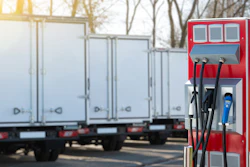














ABB E-mobility unveiled at ACT Expo 2026 in Las Vegas its new OM X-Series distributed charging system, designed for high-demand applications such as trucking depots and autonomous vehicle fleets. Housed in a container-like cabinet, the system uses fully liquid-cooled, IP65-rated power modules to withstand continuous operation while minimizing maintenance needs.
Built for scalability, the OM X-Series can expand from 800 kW to more than 10 MW through a built-in DC bus, allowing site operators to grow charging capacity without major infrastructure upgrades. The system also features module-level redundancy for uninterrupted operation. Enhanced driver-focused software includes charging status audio cues, live charging data, and range-mapping tools to improve the EV charging experience.
Clean Trucking spoke with Christopher Thompson, head of product and portfolio marketing at ABB E-mobility to learn more.
00;00;00;05 - 00;00;26;06
Jay Traugott
Is this the most heavy duty electric truck charging system on the market? AB mobility released their Om series in May of 2026. This is a charging system that can continuously operate at megawatt levels, scaling up to ten megawatts with no downtime while maintaining a 98% efficiency rate. This high utilization potential and high efficiency being a faster return on investment for owners.
00;00;26;07 - 00;00;35;22
Jay Traugott
But how does it work? In this video, we speak with Christopher Thompson, head of product and portfolio marketing at AB mobility, to find out. And to.
00;00;35;22 - 00;00;41;15
Jay Traugott
Get stories like these delivered straight to your inbox, sign up for our newsletter using the link below.
00;00;41;17 - 00;00;53;10
Christopher Thompson
So what I would like to do very first is explain where the power comes from. This is our new X series cabinet and let's just dive right into it. So let's do it. So it looks like a regular.
00;00;53;10 - 00;00;55;20
Jay Traugott
Storage container from the outside. Exactly.
00;00;55;23 - 00;01;27;26
Christopher Thompson
But inside what we have is our new IP 65 in-house power modules. We have the ability to get the heat out of here because we know heat is an enemy of efficiency and power, and then the ability down here to disperse the energy to the new charge, post the new universal charge post that we're displaying today. So we have built this to be able to deliver the lowest price per kilowatt hour to a site.
00;01;27;26 - 00;01;49;02
Christopher Thompson
So what does that mean? What you see here, these are liquid cooling. So these are liquid cooled power modules. So you just put your hand on there and you feel how cool these are. These are IP 65 rated. Now what does that mean. That means this is completely enclosed. So all the circuits all the boards everything is enclosed.
00;01;49;02 - 00;02;17;14
Christopher Thompson
So you could basically open this up again in 15 years. And it would look exactly the same because you need that protection for the wear and tear of 80, 90% utilization in the industry. And what's also great when you're trying to get to that lowest price per kilowatt hour, if you have built in redundancy. So one of these could be replaced in the side would still be up, and then I'd just swap in a new power module, kind of like a server rack in the computer industry.
00;02;17;15 - 00;02;18;25
Jay Traugott
That's a great comparison. Yeah.
00;02;18;26 - 00;02;38;07
Christopher Thompson
Yes. And then what you have down here, what we call our DC bus, you are able to actually link and expand these cabinets as your site grows. So they can just expand the site without having to rebuild the site. So now what I would like us to do is maybe we go over and just look at the innovation in the power module.
00;02;38;08 - 00;02;38;23
Jay Traugott
Sure, let's.
00;02;38;23 - 00;03;03;23
Christopher Thompson
Do it. Perfect. So let's walk over here to the left. Now these are sick, liquid cooled power modules, completely designed and manufactured in-house in Valdarno in Italy. Now, what makes this unique? As you saw the cables, you have the quick slop for the liquid coming in and coming out. And now maybe we just turn over here to the left and I want to show you something very, very cool.
00;03;03;23 - 00;03;27;14
Christopher Thompson
So what I'd like you to notice right here is you have the liquid in, but then here you have a path. Where does the liquid go? Now we are able to do that because it actually cools all the electronics inside. So we know exactly how we built the board, how we built the power module so it cools it and gives the cooling exactly where it's needed.
00;03;27;15 - 00;03;49;18
Christopher Thompson
It's not just a flush cold plate because you don't need that, because every component needs to be cooled at a different rate and a different time, different temperature. And it's really built for those high utilization sites of autonomous vehicles, maybe trucking depots, where you are really trying to capture the lowest cost per kilowatt hour delivered to have enough margin to make your business case work.
00;03;49;19 - 00;04;15;07
Christopher Thompson
Now, we've talked about the power getting it from the source. How do we deliver it with our in-house power modules. Now let's go to the consumer experience. So this is our new universal charge post design. And what we've done here is we've added a payment station. Why do we do this. Well maybe for trucking companies they don't want to pay and they just want like an RFID.
00;04;15;07 - 00;04;26;28
Christopher Thompson
But they don't want a payment terminal on every charge post. So you can put maybe a payment station for every six, every seven, because this is something to lower the cost of. Maybe they would like that.
00;04;26;29 - 00;04;28;14
Jay Traugott
You can customize it like that.
00;04;28;15 - 00;04;29;15
Christopher Thompson
We say configure.
00;04;29;16 - 00;04;32;05
Jay Traugott
Configure it. Yes. It's cool that you're able to configure it.
00;04;32;08 - 00;04;56;25
Christopher Thompson
Exactly. Now what we've added since last year when we did this demonstration is we added a couple of cool things like sound and charge map that we would like to take you through. So let's just turn that on. So you hear it going up. And now let's say I take this to do a standard charging experience. You hear that sound like connect to the vehicle because I'm holding it for a while.
00;04;57;00 - 00;05;27;02
Christopher Thompson
And then when I plug in and now depending on where you are, you have software that's completely configurable. This is like for California where I need to confirm. Now you have the ability to pay no payment terminals. So I use my phone. That's a success. Now we start to charge in progress. What is unique here is we don't look at kilowatts delivered because people think in how far can I go?
00;05;27;03 - 00;05;48;19
Christopher Thompson
How fast can I get there. So we are looking at a range map to say where can I drive to? Because that's the most important. How far can I go? Where can I get to, where is my next station? And then if I need, I can also geek out with what is my charge curve. And then if you have a phone, I don't know if you have a phone with.
00;05;48;19 - 00;05;49;15
Jay Traugott
You, I do.
00;05;49;16 - 00;05;57;05
Christopher Thompson
You can scan the follow of my charge where we build into API, so you can take that with you.
00;05;57;06 - 00;06;03;11
Jay Traugott
It's scan this here.
00;06;03;14 - 00;06;18;18
Christopher Thompson
And so you have let's say the same let's say configuration, the ability to have the information at your fingertips as you move on. Wow. So you can imagine as a rental car maybe you want like an applet versus a deep integration at the moment.
00;06;18;18 - 00;06;24;16
Jay Traugott
But it's so cool you're able to actually monitor it yourself. Exactly. A personal device.
00;06;24;17 - 00;06;31;15
Christopher Thompson
Exactly. And we will not build the app, but we give the freedom to have those APIs available to our customers.
00;06;31;15 - 00;06;32;15
Jay Traugott
That's really cool.
00;06;32;17 - 00;06;56;17
Christopher Thompson
Yeah. So let's put that back. So I return the connector again. Sound I leave that. Thank you for charging with us. I close you have the ability to add a media module. And this allows you to say okay, what do I want to use that space for? I'm finished. And then you repeat the process. And again this is really built.
00;06;56;17 - 00;07;03;12
Christopher Thompson
We took you through the whole flow. Obviously if you've done it one time you just do it and then you plug in and it becomes very natural.
00;07;03;13 - 00;07;15;04
Jay Traugott
Yeah. Speaking of which, have you noticed there's a bit of a learning curve for some fleet drivers who are new to this? Are they picking up on the technology pretty quickly, or are they still just trying to get the old diesel stuff out of their head?
00;07;15;10 - 00;07;39;06
Christopher Thompson
I would say they're picking up pretty quickly. From what we've seen in the market. We have a unique position to answer. A lot of these inquiries from customer, you know, potentially during certain holiday season, some companies hire like 20, 30,000 drivers who are probably like driving an EV for the very first time. So maybe you put additional text how to help them.
00;07;39;11 - 00;07;51;14
Christopher Thompson
You know, don't forget your keys. And that's why we also thought about sound and text. Because for them, as I did, I plug in. Did it go incorrectly? Besides visually of just turning something red you give an audio cue.
00;07;51;15 - 00;07;59;23
Jay Traugott
I think the audio, the sound, what you were mentioning was a very smart idea, especially for awake. And you're just saying the new people who are new to this technology.
00;07;59;24 - 00;08;03;07
Christopher Thompson
Yeah, that's that's what we learned from our research, talking with.
00;08;03;07 - 00;08;09;25
Jay Traugott
Customers and very interesting. Thank you very much. And I can't wait to see what you guys have next year. At first, though, it'll be very interesting.