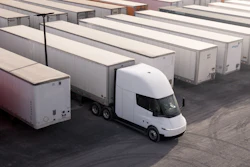














CCJ editor Jason Cannon recently caught up with Tesla's Class 8, battery electric rig. It's as close as he's been to the truck since seeing a prototype version in-person at it's public debut in 2017.
Inside you’ll find a center seat flanked by two 16-inch QHD touchscreens. In those screens are customizable views from the truck’s 10 cameras and features commonly found in driver information displays like truck status, routing and maps, air conditioning, and more. Most functions in the Semi are controlled by the displays.
Under the chassis, the Semi is built for performance. It features three independent motors on the rear axles, delivering up to 800 kilowatts of drive power making the equivalent of 1,000 horsepower.
The tri-motor configuration uses one motor designed for efficiency on the highway, while the other two are for acceleration and torque.
Contents of this video
Tesla is hoping to crash the commercial truck party this year when its long-awaited and often-delayed all electric Class 8 tractor comes to market.
I’m CCJ editor Jason Cannon and join me on this up-close look at the Tesla Semi – well, as close as I’ve ever been to it.
Tesla first debuted its electric Class 8 in 2017 with plans for commercial production in 2019. That didn’t happen, but after almost 9 years the company seems intent on bringing its Semi to mass market this year.
I recently caught up with a Semi model in Nashville, and while I couldn’t drive it, I did crawl all over it and around it.
Getting inside the truck is more like walking into a house that climbing into a rig. The rear- hinged doors look more like your front door than your truck door. Egress inside is pretty simple. You just walk in. It’s just a couple of steps. No sling shotting yourself into this cab. If you’ve got bad knees or joint pain, there’s probably no truck in the world easier to get into that the Semi.
You step into the cab behind the seat.
Inside you’ll find a center seat flanked by two 16-inch QHD touchscreens. In those screens are customizable views from the truck’s 10 cameras and features commonly found in driver information displays like truck status, routing and maps, air conditioning, and more. Most functions in the Semi are controlled by the displays.
Semi comes standard with active safety features that pair with advanced motor and brake controls to deliver traction and stability in all conditions.
The center driving position does feel a little weird, but like anything else, the more you do it, the quicker you’ll get used to it, I suppose. It’s comfortable. It’s just different.
The view is panoramic. It’s really pretty remarkable; like a cabover but with more side glass.
There’s about 6 and a half feet of headroom in the truck, and the center seat puts the driver about a wing-span’s length from the side windows, making the cab feel that much larger.
Tesla doesn’t offer a sleeper option for Semi but there is plenty of room for one. The location of the doors could make sleeper layout complicated, though. The Semi’s doors would normally be the wall where you’d have storage or a refrigerator. The square inches are definitely there.
This truck had a jump seat on the rear wall for a passenger.
Under the chassis, the Semi is built for performance. It features three independent motors on the rear axles, delivering up to 800 kilowatts of drive power making the equivalent of 1,000 horsepower.
The tri-motor configuration uses one motor designed for efficiency on the highway, while the other two are for acceleration and torque.
Tesla offers two range models: the Standard Range at 325 miles, and the Long Range at 500 miles on a single charge. This is the 500-mile range model. Power consumption on both models is 1.7 kWh per mile – that’s approximately 19.8 miles per gallon equivalent.
Range is only half the story; the other half is charging. Tesla’s Megawatt Charging System delivers up to 1.2 megawatts of peak power, and can replenish 60% of the range in just 30 minutes—pretty good timing for a mandatory rest break. The network is expanding fast. Tesla has identified 66 planned Megacharger sites across 15 states, focusing on high-traffic corridors like I-5 and I-10.
Despite its many delays and still lack of concrete pricing information, Tesla remains committed to deliveries getting underway in 2026. Series production will take place at a now-completed Gigafactory in Nevada.