













What you need to know:
- Executives at ACT Expo 2026 identified heavy-duty trucking and Class 8 hydrogen fuel cell trucks as major near-term opportunities for the hydrogen economy
- Hydrogen fuel leaders say the industry is shifting from hype to a more pragmatic phase focused on commercial deployment and long-term market growth
- Industry leaders said high hydrogen fuel costs, limited hydrogen infrastructure, and policy uncertainty remain key barriers to large-scale adoption
- Toyota and partners including cellcentric and Hyroad Energy are expanding hydrogen truck deployments and investing in new hydrogen fueling infrastructure in California
After several turbulent years marked by rapid investment, shifting government policy, and stalled projects, leaders across the hydrogen fuel sector are signaling a transition from hype-driven expansion to hard-earned pragmatism.
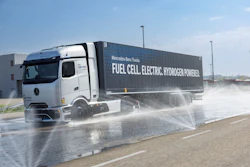
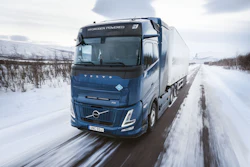
That transition is already visible in the transportation industry, where OEMs including Hyundai, Daimler Truck, Volvo Group, and Toyota are continuing targeted hydrogen investments and commercial deployments.
Still, industry leaders caution that the road ahead will not be simple.
"Hydrogen is just really one of these markets that is suffering from the rollback on federal level research and development and deployment," explains Nate Springer, vice president of market development at TRC and lead author of the annual State of Sustainable Fleets Report.
Hydrogen market recalibration
At ACT Expo 2026 in Las Vegas, executives from companies including Bosch, Toyota North America, cellcentric, and Total Hydrogen Solutions delivered a consistent message during hydrogen-focused panel discussions: the hydrogen economy is not collapsing—it is recalibrating.
[Related: Hyroad Energy, Total Hydrogen Solutions strike deal to expand hydrogen truck fueling in Texas]
Speakers described an industry entering a more disciplined and economically focused phase. After years of dramatic swings in optimism and investment, many said the sector now has a clearer understanding of what is required to build a sustainable hydrogen market.
 Hydrogen industry experts participating in a panel discussion at the ACT Expo 2026.Clean Trucking
"We've been through a dramatic up-and-down cycle," explained Dr. Stefan Becher, vice president of fuel cell solutions at Bosch. "But we now understand far more about what works—and what doesn't. In many ways, we're back where we were five years ago, just a lot smarter."
Hydrogen market outlook and industry challenges
A recurring theme throughout the sessions was that demand—not supply—remains the industry's biggest challenge. Panelists noted that hydrogen production can scale quickly when supported by investment and policy, but long-term success depends on aligning demand growth, infrastructure deployment, and regulation simultaneously.
"We see policy development as really market development and market development I view as a forerunner of business development and sales," said Frank Wolak, president and CEO of the Fuel Cell and Hydrogen Energy Association. "So we're kind of out there really trying to frame what comes next, dealing with challenges and opportunities as they arise."
Heavy-duty transportation emerged as one of hydrogen's strongest near-term opportunities. Compared to light-duty passenger vehicles, trucking fleets offer concentrated fuel demand, predictable routes, and higher fuel consumption—factors that make it easier to justify fueling infrastructure investments and achieve economies of scale.
Even so, market and infrastructure realities continue to slow adoption. Hydrogen fuel pricing remains one of the industry's largest barriers, with panelists emphasizing that hydrogen must become cost-competitive with diesel and other fuels before fleets will adopt it at scale. Infrastructure deployment also presents a chicken-and-egg problem, as fueling stations, supply chains, and vehicles all must expand together.
"The 10-ton station... what that means is for every $10 or $20 million station project, is that you have to plan on deploying two to 300 trucks around that station," added Bart Sowa, program director at GTI Energy. "So the supply and demand are balanced, and hydrogen production varies widely. This is cost delivered to the station that we modeled. It can range anywhere from $1 to $12 per kilogram. Costs vary significantly by region, depending on energy prices and feedstock availability."
Several speakers also reflected on lessons learned from earlier light-duty hydrogen vehicle programs, where promising deployments struggled because infrastructure growth and policy support failed to keep pace. Those experiences reinforced the need for coordinated long-term planning across the hydrogen ecosystem.
"The challenge for all of us is do we want to keep looking at things that move forward and use the next two years to build momentum, or do we just want to jump off the plateau," Wolack continued. "We see policy development as really market development, and market development, I view, as a forerunner of business development and sales. We're kind of out there really trying to frame what comes next, dealing with challenges and opportunities as they arise."
Despite uncertainty surrounding U.S. policy, speakers emphasized that hydrogen investment continues globally.
Countries including Canada, South Korea, Japan, and China, along with much of Europe, are continuing to invest in hydrogen infrastructure and heavy-duty transportation applications.
To the surprise of some attendees, Greg Heller, president of Total H2 Solutions, acknowledged that "sometimes hydrogen doesn't make sense" for certain applications, though he did not elaborate further.
Overall, speakers argued that hydrogen technology itself is no longer the primary obstacle. Instead, the industry's central challenge is building economically viable markets capable of scaling through coordinated investment, infrastructure expansion, and sustained demand growth.
Toyota's hydrogen bet
One company reinforcing that message at this year's show was Toyota, which used its presentation to outline how hydrogen deployment is evolving from future-oriented vision to targeted commercial execution.
Last month, Toyota announced it would join cellcentric, the collaboration formed in 2021 by Daimler Truck and Volvo Group to design and manufacture hydrogen fuel cell systems for long-haul heavy-duty trucks.
Toyota executives identified heavy-duty trucking as a key near-term opportunity because of its concentrated fuel demand and significant emissions footprint—conditions they believe are particularly well suited for hydrogen adoption.
"The case for hydrogen hasn't changed. The fundamentals are stronger than ever. For this industry—from OEMs, suppliers, and infrastructure providers—who have weathered the challenges of the past year, it's important to continue believing in the power of hydrogen," emphasized Thibaut de Barros Conti, vice president of business development at Toyota. "The hydrogen ecosystem only succeeds when supply and demand are built in parallel—and that requires commitment and collaboration from all of us."
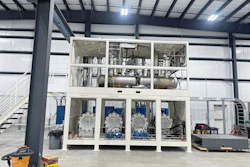
The company also highlighted plans to build a vertically integrated hydrogen ecosystem, including a new liquid hydrogen fueling agreement at its North American Parts Center in California. Initial operations will support Class 8 fuel-cell trucks within Toyota's own fleet before expanding to external operators and permanent fueling infrastructure.
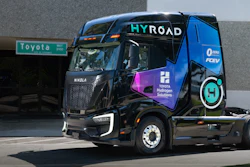
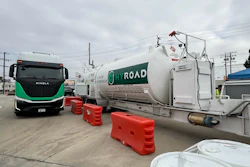
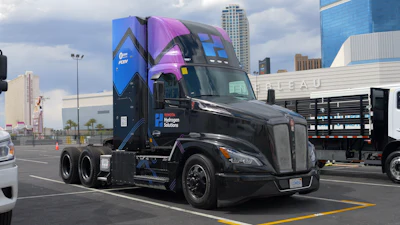
At ACT Expo 2026, Toyota also announced a hydrogen partnership with Hyroad Energy, which acquired the commercial assets—including 117 fuel cell electric Class 8 semis—from the now-bankrupt Nikola Motors last summer.
[Related: Hyroad Energy partnership aims to boost California's hydrogen trucking network]
Under the agreement, the companies plan to deploy 40 hydrogen fuel cell Class 8 trucks across Southern California in collaboration with the Texas-based firm.
Like many of the panelists, Toyota stressed that hydrogen scale-up depends on synchronized growth between vehicles and fueling infrastructure, reinforcing the industry's view that infrastructure remains the central constraint. Alongside freight applications, the company also pointed to growing momentum in hydrogen-powered buses, stationary power systems, and construction equipment—signs of a more focused and commercially driven phase of hydrogen development.
"There's no single catalyst for realizing the hydrogen society we should have… that we can have… and that we WILL have. At Toyota, we believe that hydrogen products and infrastructure are like flowers and bees—they need each other to exist and mutually benefit one another," concluded Barros Conti.