













What you need to know:
- Volvo Trucks begins European on-road testing of hydrogen combustion engines for heavy-duty trucks, targeting commercial launch 2030
- North America rollout remains unconfirmed as hydrogen truck strategy depends on infrastructure, regulation, and regional energy availability
- Volvo's three-path decarbonization strategy—battery-electric, fuel cell, and renewable fuels—positions hydrogen combustion as a long-haul solution
- HPDI-powered hydrogen engines promise lower costs, diesel-like performance, and reduced C02 emissions despite limited U.S. hydrogen fueling infrastructure
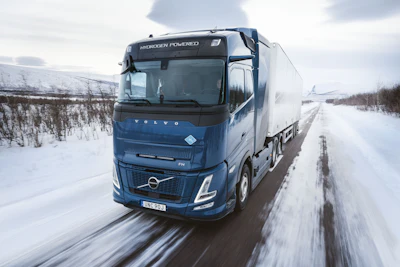
Volvo Trucks has announced the start of on-road testing in Europe for its hydrogen combustion engines designed for heavy-duty trucks, with plans to bring them to the European market before 2030.
The manufacturer initially revealed its hydrogen-combustion engine development program at ACT Expo 2024. As of now, Volvo has not confirmed plans to launch in the North American market, though it hasn't ruled out the possibility.
The company says it's continuing to focus on its three-path strategy to reach net-zero emissions (battery-electric, fuel cell electric, and renewables) that's designed to provide flexibility across regions—including North America—depending on infrastructure and energy availability.
Hydrogen fueling infrastructure remains largely absent across most of the U.S., with availability currently limited to select areas in Southern California, Arizona, and Texas.
[Related: After Nikola's fall, Hyroad Energy rises in hydrogen trucking]
While hydrogen combustion engines can be slightly less efficient than their fuel cell counterparts in some situations, they are significantly cheaper to produce and take up less space, with a smaller impact on vehicle payload.
[Related: Hydrogen combustion could drive down hydrogen costs]
"On-road testing is an important milestone for our hydrogen combustion engine trucks. I feel confident that they will be the best in the industry if you look at fuel efficiency, power, torque and drivability. Customers will be able to operate them just like diesel trucks. Our experience with HPDI technology in more than 10,000 gas-powered trucks is strong proof of its performance," explained Jan Hjelmgren, head of product management at Volvo Trucks.
 Volvo Trucks
Volvo says it's developing hydrogen-powered trucks that aim to be more efficient, use less fuel, and deliver stronger performance than traditional hydrogen engines. This improvement comes from a system called High Pressure Direct Injection (HPDI) technology that'll be supplied by Cespira. It works by injecting a small amount of fuel at high pressure to trigger ignition, then adding hydrogen for power.
In fact, Volvo already uses the technology in its gas-powered trucks, with more than 10,000 vehicles equipped with HPDI sold globally. This new hydrogen engine builds on the company's existing diesel technology, offering similar performance while significantly reducing C02 emissions.
"We see great potential for hydrogen combustion engine trucks and they will have a role to play in the transformation to zero tailpipe emission transport. Several technologies will be needed to decarbonize. As a global truck manufacturer, we offer a variety of decarbonization solutions and help our customers choose the best alternative based on transport assignment, available infrastructure and green energy prices," Hjelmgren added.