













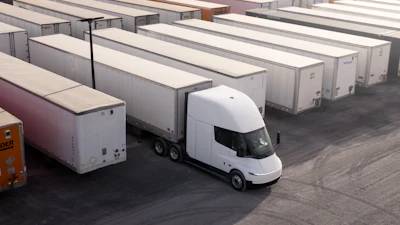
The California Air Resources Board (CARB) officially relaunched the California Clean Fuel Rewards (CCFR) program late last month, introducing a new version of the statewide incentive initiative designed to accelerate adoption of zero-emission medium- and heavy-duty electric trucks.
The revamped program changes how fleets access funding by making rebates available immediately at the point of sale through authorized dealerships and retailers throughout the Golden State. Rather than waiting for reimbursement after purchasing a vehicle, eligible buyers can receive discounts upfront.
Funded through revenue generated by California's Low Carbon Fuel Standard (LCFS), the program is expected by state officials to become the largest utility-administered electric truck rebate initiative in the country. It includes $250 million in available funding this year, with more than $1 billion projected through 2030.
[Related: CARB unveils $1B Clean Fuel Reward program to accelerate zero-emission truck adoption]
However, one segment of the trucking industry will not have access to the full benefit: fleets operating more than 20 vehicles.
That limitation has drawn criticism from some industry stakeholders, who argue that California's strategy may unintentionally slow zero-emission truck adoption rather than accelerate it.
"By pulling the rug out from mid-sized operators, CARB has successfully put zero-emission adoption completely out of the money," said Robert Loya, chief executive officer of Harbor Trucking Association.
A major incentive—but not for everyone
Under CCFR, eligible commercial vehicle buyers can receive rebates ranging from $7,500 to $120,000 per vehicle at the time of purchase.
The program covers a wide range of commercial vehicles, including:
- Drayage trucks
- Class 8 tractors
- Box trucks
- Delivery vans
- Other medium- and heavy-duty fleet vehicles
Public fleets may also receive incentives for smaller Class 2b commercial vehicles, including business-use pickup trucks.
The program is administered by Southern California Edison on behalf of a coalition of California utilities that includes Pacific Gas and Electric Company, San Diego Gas & Electric, Los Angeles Department of Water and Power, and Sacramento Municipal Utility District.
CCFR is intended to complement—not replace—the state's existing commercial vehicle incentive programs, including the Hybrid and Zero-Emission Truck and Bus Voucher Incentive Project (HVIP), which has provided more than $1 billion to help fleets transition to cleaner vehicles.
But under current rules, fleets with more than 20 trucks cannot combine CCFR funding with HVIP vouchers for Class 8 vehicle purchases. Smaller fleets can stack the incentives, while larger fleets must choose between the two programs.
That distinction has become the center of a broader debate over whether California is targeting incentives toward the fleets best positioned to deploy early-generation electric trucks.
"A fleet with 30 or 40 trucks is not a multinational retail conglomerate with an endless ESG balance sheet; these are overwhelmingly local, family-owned drayage businesses operating on razor-thin margins," Loya argues.
Small fleets may face the greatest barriers
Clean Trucking spoke with an industry source familiar with CARB's strategy who questioned whether prioritizing smaller fleets is the most effective approach. The source requested anonymity.
According to them, CARB's approach may be influenced partly by concerns about public perception—specifically, how large incentive payments to major corporations could be viewed by taxpayers.
The source characterized the decision as a choice between "optics and functionality," arguing that larger fleets may actually be better positioned to absorb the challenges associated with first-generation zero-emission technology.
"The people who should be getting the most robust incentives are larger fleets, not smaller. Smaller fleets are least likely to own their own land, have open lines of credit with financial institutions, and have reserve vehicles just in case of breakdowns."
The argument is that many smaller trucking companies lack the financial cushion and operational flexibility needed to experiment with emerging technology.
For a small fleet, losing even one truck can have an immediate impact on revenue.
"Small fleet owners are asking themselves, 'Why would I put my faith in unproven tech right now?' It's all first-generation technology with a lack of infrastructure. What happens if it's a five-truck fleet and one of them goes down and there isn't an OEM-provided loaner?"
The source said purchase incentives alone do not address those operational concerns.
"CARB is basically saying we'll give small fleets more money up front to figure things out. But that's not the reality of getting more ZEV trucks on the road."
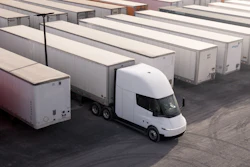
While a $120,000 incentive for a Class 8 battery-electric truck, such as the Tesla Semi, represents significant support, the source argued that the remaining costs remain difficult for smaller operators to absorb.
"$120,000 is generous, but at the same time, it's not a lot when the truck costs $300,000 and I'm used to buying a $50,000 used diesel vehicle."
Even after incentives, the buyer may still need to finance hundreds of thousands of dollars.
"Smaller fleets will need to come up with another $230,000, plus taxes. That means getting use to truck payments, which interferes with cash flow. It's all about cash flow. One thing goes wrong and you're in trouble."
Technology risk remains a major hurdle
The source argued that policymakers may be focusing too heavily on purchase price while underestimating the operational risks associated with early zero-emission trucks.
For many smaller operators, the concern is not simply whether they can afford the truck—it is whether the truck can reliably generate revenue every day.
Battery-electric trucks continue to face challenges involving charging availability, range requirements, maintenance support, and uncertain resale values—currently valued at $0 because no secondary market exists. Those concerns can be especially significant for smaller fleets that cannot easily replace a vehicle if it becomes unavailable.
The source suggested larger fleets are better positioned to help validate the technology because they often have more capital, additional vehicles, dedicated facilities, and greater ability to absorb downtime.
"They don't hate corporate America," the source said of CARB. "They just don't want to give them more than what they deserve."
CARB defends its approach
CARB pushed back against the criticism, saying the incentive structure was not recently changed and that HVIP stacking rules have remained consistent since guidance took effect on Dec. 9, 2025.
Under the current policy, fleets with 20 or fewer trucks can combine HVIP vouchers with CCFR funding for Class 8 purchases. Larger fleets must select one incentive program.
CARB told Clean Trucking the structure is designed to address the greater financial challenges faced by smaller operators while ensuring public funding is distributed equitably.
The agency pointed to enhanced HVIP voucher amounts for qualifying small fleets and its Innovative Small e-Fleets (ISEF) pilot program, which explores alternative ownership models such as all-inclusive leasing, truck-as-a-service arrangements, and peer-to-peer truck sharing.
Responding to concerns that small fleets may struggle with downtime and reliability issues, CARB said participation remains voluntary and market-driven. Fleets can determine whether zero-emission vehicles fit their operations and when adoption makes sense.
The agency also noted that HVIP-eligible vehicles must meet minimum warranty requirements and have service and repair support available in California. Through ISEF, some participating business models may also provide backup vehicles during maintenance periods.
Large fleets still have access to incentives
CARB also rejected the idea that funding has been redirected away from larger fleets.
The agency said large fleets remain eligible for either HVIP or CCFR incentives and can receive up to $120,000 per Class 8 truck through one program. CARB said that amount is designed to help achieve three-year total cost-of-ownership parity with a new diesel truck.
On the question of used electric truck resale markets, CARB acknowledged that a secondary market has not yet fully developed.
The agency said increased deployment through small-fleet incentives and combined funding opportunities could help establish future residual values. CARB added that it is evaluating additional solutions with industry stakeholders, including potential residual value guarantee programs.
Who should lead the transition?
The debate over CCFR reflects a broader challenge facing policymakers: how to accelerate adoption of new technology while accounting for the realities of the trucking business.
California's incentive programs aim to put more zero-emission trucks on the road, but industry critics argue that the fleets receiving the largest incentives should be those most capable of managing early technology challenges.
CARB, meanwhile, maintains that prioritizing smaller fleets creates a more equitable transition while still allowing larger operators to participate.
As California continues its push toward zero-emission transportation, the question remains whether the fastest path to widespread adoption is through broad participation among smaller operators, or through early deployments by fleets with the resources to overcome the technology's remaining hurdles.
While CARB views the policy as an equitable compromise, industry advocacy groups warn that the restriction will stall momentum at a critical juncture.
"Slowing down adoption through punitive incentive caps is the absolute worst policy choice at the absolute worst time—especially given the absence of any realistic bridge to infrastructure readiness," said Loya.