













What you need to know:
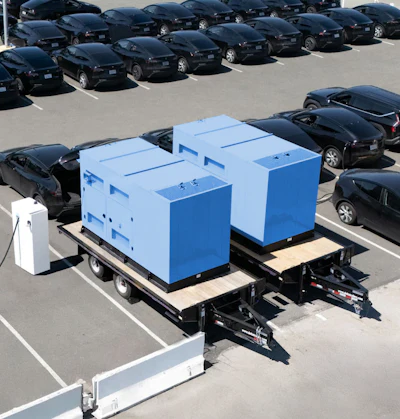
- Mobile EV charging for fleets is being deployed by SparkCharge as an off-grid charging solution that bypasses slow grid-connected infrastructure and enables deployment in days
- Grid bottlenecks driving EV adoption are highlighted by CEO Joshua Aviv, who points to electrical grid limitations and long build timelines pushing fleets toward distributed energy solutions
- Charging-as-a-Service (CaaS) turns EV charging infrastructure into a monthly service model, reducing upfront costs and supporting commercial fleet electrification
- Nationwide mobile charging expansion enables operations across all 50 states, supporting fleet EV adoption, logistics electrification, and mobile charging deployment in diverse regions
The electrification of commercial fleets is accelerating, but it is running into a structural constraint that technology alone has not solved: the speed and capacity of the electrical grid. For operators evaluating when and how to transition away from diesel, the challenge is no longer vehicle availability—it is infrastructure readiness.
That gap is exactly where SparkCharge has positioned its model.
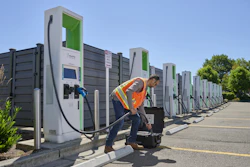
Founded in 2017, the Somerville, Massachusetts-based company is building a mobile, off-grid charging network designed to bypass the long timelines and capital-intensive construction of traditional charging infrastructure, allowing fleets to deploy charging capacity in days instead of waiting years for fixed sites to be permitted and connected to the grid.
To keep its mobile battery systems supplied with energy, SparkCharge recharges units by plugging them into high-power public charging infrastructure when available for faster turnaround, using lower-capacity on-site grid connections for slower trickle charging where needed, or rotating depleted units with fully charged batteries stored at centralized logistics hubs to ensure continuous availability of charging assets.
"We will be in this perpetual cycle of always trying to play catch up. And I don't think the grid ever will, quite frankly," said CEO and founder Joshua Aviv in conversation with Clean Trucking at ACT Expo 2026. "I think we will get to a point where we will see such mass adoption of EVs that it'll be hard for the grid to keep up. And I think that's where off-grid charging comes into play."
[Related: Watch the Top 8 reveals from ACT Expo 2026]
A grid that can't scale fast enough
At the center of SparkCharge's thesis is a mismatch between infrastructure timelines and fleet adoption speed. While EV demand from commercial operators is accelerating, the physical buildout of charging infrastructure remains slow and heavily constrained by permitting and utility upgrades.
"When we think about the speed at which infrastructure has traditionally been rolled out, it's taken years," Aviv explained. "So if you wanted to really roll out, call it a 20, 30, 40-port charging station hub, you're looking at anywhere from five to eight years in some places across the United States and it gets even worse on a global scale."
That delay, he argues, creates a structural lag that won't resolve on its own. "So when we think about what is it going to take for the grid to catch up, the grid would have to move a lot quicker and it's just not designed for that."
Instead of waiting for that gap to close, SparkCharge's approach is to bypass it through mobile, distributed energy deployment.
[Related: Zeem Solutions' LAX EV fleet depot just surpassed 350,000 charging sessions]
From consumer EVs to fleet-led adoption
The company has seen the center of gravity in EV adoption shift over the past several years. Early growth was driven largely by consumer vehicles, but fleets are now becoming the dominant source of scaled demand.
"I think we've only recently started to see fleets adopt EVs at scale," Aviv said. "I think when we first started out, everything was driven by the consumer. But now we're realizing that fleets are actually probably going to be the predominant adopters of electric vehicles at scale."
Within that shift, certain segments are leading the transition. "We're seeing a lot of passenger car fleets. So this is like your autonomous vehicle fleets, your rideshare fleets. They found that adopting electric vehicles saves them money. And I think once they've realized that, they're never going back."
 Battery-electric vehicles, including a Rivian, and two Ford E-Transits, receive charging from a SparkCharge mobile charger.SparkCharge
The next phase, Aviv added, will likely come from heavier transport categories. "I think the frontier for fleets is going to be semis, large, 18-wheeler full electrification of that class of fleet."
Distributed energy network model
SparkCharge describes itself as a distributed energy network for fleets, designed to deliver charging without dependence on permanent infrastructure. The system is built to support a wide range of customers, from small operators to large-scale logistics networks.
"So at SparkCharge, we are North America's and now the world's largest distributed energy network where we provide fleets with off-grid charging at scale," Aviv said. "We service small fleets that are trying to get off the ground with a couple of cars, as well as massive fleets that are using gigawatt hours of energy on a monthly or yearly basis."
The key distinction is flexibility: energy can be deployed where it is needed rather than where infrastructure exists.
"What this means is that we can deploy energy, we can replace the utility, we can deploy energy in remote locations, we can work behind the meter, we can basically allow a fleet to get up and going in just about any scenario in any location," he added.
[Related: Tesla unveils Megacharger and Basecharger for Semi fleet charging]
Charging-as-a-Service and capital constraints
A central part of SparkCharge's strategy is its Charging-as-a-Service (CaaS) model, which converts charging infrastructure from a capital expenditure into an operating expense. Instead of purchasing and installing hardware, fleets subscribe to a bundled service that includes energy, deployment, and system management.
"We do everything from A to Z. So we're a full one stop shop," Aviv said. "So a fleet comes to us and say, 'Hey, we've got a hundred cars. We need to get them on the road. We want them electrified and going.' We provide everything from the energy to the charging stations to the management itself. We do all the setup, we do all the power, and then we make sure that that site stays reliable throughout the time that they're using it."
This structure is particularly relevant for fleets already facing large upfront costs for vehicle procurement.
Hardware flexibility and cost pressure
Beyond deployment, SparkCharge also focuses on compatibility with existing charging ecosystems. Rather than locking customers into proprietary systems, the company supports a hardware-agnostic model.
"We are hardware agnostic," said Dino Livakovic, head of sales and business development at SparkCharge. "There are customers that have already done testing, integration, validation with a certain set of chargers. And they have a certain preference of which they'd like."
That flexibility extends into cost structure as well. "A lot of folks don't want to do that. So you have companies that are having to put capital out of their own pockets to buy the vehicles and they're like, 'Well, I got to dish out more for charging.' So our model comes in really handy where we provide that and bake that into digestible monthly rates."
Market expansion and geographic reach
SparkCharge now operates across all 50 U.S. states, supporting deployments in both established EV markets and emerging regions. While activity is concentrated in states like California, Texas, and Florida, the company is also expanding across the Southeast, Pacific Northwest, and Northeast corridors.
In some cases, regional infrastructure conditions further reinforce the need for alternative charging solutions. "Denver has one of the dirtiest grids in the country," Livakovic noted. "They're super coal heavy."
These variations highlight the uneven nature of grid emissions and reliability across different markets.
Mobile infrastructure and operational reality
A key advantage of SparkCharge's system is mobility. Instead of building fixed infrastructure, the company deploys charging capacity directly to fleet locations—including remote or temporary sites.
"One of the neat things again about our model is we are fully mobile," Livakovic said. "So if you give us one or two business days extra, we'll get there. We'll move our assets, we'll move our techs."
That capability extends even to highly remote environments. "We can be in the middle of a cornfield in, I don't know what state… but we can be there."
Infrastructure that moves with demand
As fleet electrification accelerates, SparkCharge's model is built around a simple premise: energy access should not depend on where infrastructure has already been built. Instead, it should follow demand.
For Aviv, the constraint is structural, not temporary.
"So when we think about what is it going to take for the grid to catch up, the grid would have to move a lot quicker and it's just not designed for that," he said.
In that gap between demand and infrastructure, SparkCharge is betting that mobility—not permanence—will define the next phase of fleet electrification.