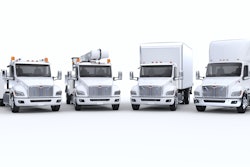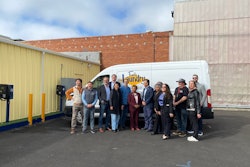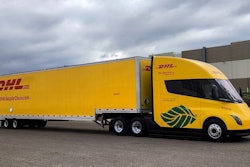











It's official: Workhorse Group and Motiv Electric Trucks have finalized their merger, first proposed last August and approved by shareholders last month, resulting in a battery-electric medium-duty vehicle manufacturer, now called Workhorse, with up to $50 million in new debt financing capacity.
[Related: Motiv customer Purolator achieves 1 million kilometers of zero-emission driving]
Approximately $10 million of that amount is accessible through a revolving credit facility, with an additional $40 million available to support supply chain costs tied to new purchase orders. These financing arrangements are expected to not only substantially shorten order-to-delivery timelines but also provide significant liquidity to support growth initiatives.
With the merger complete, Detroit-based Workhorse now possesses scalable manufacturing capacity, proven and market-ready products, and a strong go-to-market strategy, demonstrated by its successful partnerships with ten of North America's largest commercial truck fleets.
The medium-duty, battery-electric commercial vehicle market is currently valued at $23 billion.
[Related: Motiv Electric Trucks achieves 5 millionth electric mile]
Vehicle production will take place at the Workhorse Ranch in Union City, Indiana.
"At Workhorse, we're not just building electric trucks, we're building better trucks. Our software-first electric trucks are powerful, cost-efficient, reliable, safe, and comfortable—all with zero tailpipe emissions and pollution," said Scott Griffith, who became CEO of Workhorse upon the merger's completion. "Workhorse trucks perform the same or better as their internal combustion engine (ICE) counterparts, while costing far less over the lifetime of the vehicle."
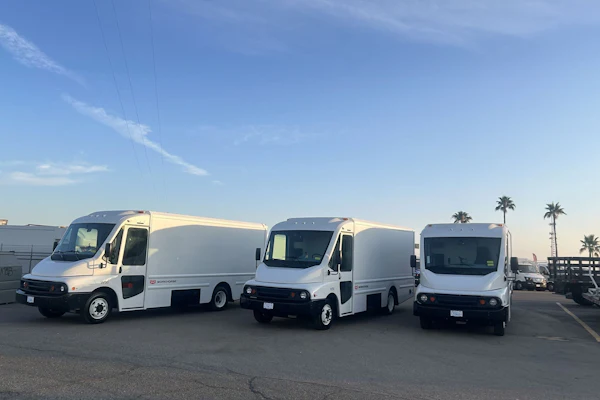
Workhorse says it's positioned to deliver value by producing advanced, cost-effective trucks with superior safety, telematics, and ergonomics. The company already serves 10 of North America's largest fleets and enters 2026 with a strong backlog for trucks, step vans, school buses, and shuttles, supported by its Indiana facility capable of producing over 5,000 vehicles annually.
The company also leverages real-world insights through its Stables project, operating both gas and electric step vans within a FedEx Ground Independent Service Provider fleet. This experience informs vehicle design, route planning, and durability testing, ensuring customer-focused solutions, Workhorse further pointed out in today's announcement.
"Looking ahead," Griffith continued, "we are going to build on our 20-plus year combined legacy in electrification and the thousand-plus electric trucks and buses we have delivered to meet the needs of our growing customer base. In doing so, we believe we are positioned to drive profitable growth, create value for our shareholders and customers and deliver on our Better Trucks, Better World ambition."
In a letter to shareholders, Griffith explained that "Our trucks, buses and shuttles are also a great fit for a large swath of the $23 billion1 medium-duty truck segment. Why? Because the use cases and the duty cycles for our vehicles are in the 'Sweet Spot' for electrification: shorter range and predictable/repeatable routes where depot-based vehicles return for overnight charging, often at lower off-peak electricity rates.
"We believe these use cases and routes are also likely to be among the best applications for autonomous vehicles in the future. Our designs anticipate an autonomous future too. In addition, we believe our B2B customer base refreshes 10 percent of its existing base of trucks every year (about 300,000 medium duty trucks and buses are purchased annually). Based on our forecasts, we believe that acquiring even 1 percent of that annual opportunity would enable us to reach profitability on an EBITDA basis."