













What you need to know:
- GreenPower Motor Company regains Nasdaq compliance, restoring Nasdaq Capital Market listing after resolving Equity Rule stockholders' equity requirement
- Reports $8.5M revenue and $4.2M net income, achieving 28% gross margin and sharply reducing SG&A expenses
- Secures up to $18M Series A Convertible Preferred financing, plus $5M term loans and new CIBC credit facility to strengthen liquidity
- Expands all-electric school bus deployment through New Mexico Zero-Emission School Bus Pilot Program and launches new U.S. production facility in Santa Teresa, New Mexico
Vancouver-based GreenPower Motor Company certainly has reasons to celebrate 2026 so far.
The manufacturer of battery-electric medium- and heavy-duty delivery and cargo vehicles, as well as shuttle and school buses, announced this week that it has regained compliance with Nasdaq listing requirements and now satisfies all applicable criteria for continued trading on The Nasdaq Capital Market.
Last August 15, GreenPower received notice from Nasdaq officials that it had fallen below the minimum US $2.5 million stockholders' equity requirement, aka the Equity Rule.
Although compliance has been restored, GreenPower says it will remain under a one-year monitoring period by Nasdaq. If it falls out of compliance with the Equity Rule again during that time, it could face delisting without the option to submit a new compliance plan. It would, however, retain the right to request a hearing before the Nasdaq Hearings Panel, which would automatically stay any suspension or delisting pending the outcome.
"Over the past few months GreenPower has completed a series of transactions including raising new capital with an equity offering of Series A Convertible Preferred Shares for up to $18 million, term loans of $5 million and a new banking relationship with CIBC including a line of credit and term loan. "These transactions have helped the Company regain full compliance with the Nasdaq listing criteria as well as with the execution of our strategic goals."
[Related: GreenPower ramps up electric school bus output with $18M financing facility]
In more good news, GreenPower reported strong financial results for the period ended December 31, 2025, generating $8.5 million in revenue and $4.2 million in net income.
The company increased revenue to $8.5 million from $7.2 million a year earlier, driven by vehicle, parts and lease sales, with vehicle gross margins of approximately 28%. GreenPower says it also reduced operating expenses, cutting SG&A to $2.4 million from $5.2 million year over year.
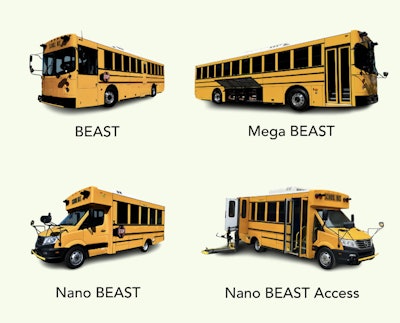
During the quarter, GreenPower took over management of New Mexico's All-Electric, Purpose-Built, Zero-Emission School Bus Pilot Program, supported by more than $5 million in state funding to deploy its Nano BEAST and BEAST school buses along with charging infrastructure. Production for these vehicles takes place in the U.S., with existing factories in West Virginia and California.
It also raised about $1.1 million through a Series A preferred share issuance, with additional tranches available that could total up to $16 million under the agreement.
Last month, the company announced that it struck a deal with the New Mexico Economic Development Department to establish a new 135,000 sq. ft. production facility in the city of Santa Teresa that's slated to become the company's new North American operations base and its U.S. corporate headquarters.
[Related: GreenPower's first all-electric buses roll off production line]
"GreenPower is very excited about the excellent progress in the deployment of all-electric, purpose-built school buses during the last quarter in New Mexico; Continuing to perform on the state sponsored, two-year, zero emissions school bus pilot project," said Brendan Riley, president of GreenPower. "This project uses the compelling West Virginia pilot project as its model but is focussed on the specific needs of New Mexico school districts where there will be challenges on deploying in both city and rural settings, challenges with charging infrastructure and operating the school buses in extreme cold weather at high elevations."