












Electrification Coalition unveils updated electric freight dashboard for EV trucks

The expanded tool maps EV truck infrastructure, funding, and policy alignment across key freight corridors.

Img 4589 Headshot
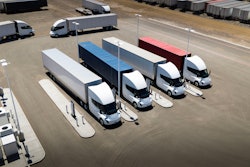
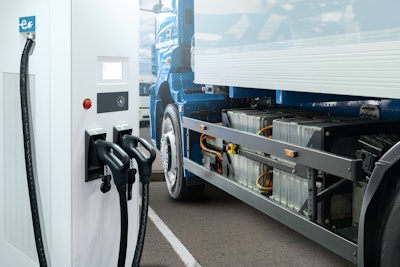
A rendering of a battery-electric semi truck parked next to a charging station.
Getty Images

What you need to know:

  • Expanded Electric Freight Dashboard integrates Zero Emission Freight (ZEF) Corridor strategy
  • Real-world EV charging data and detailed freight hubs enhance electric vehicle deployment tracking
  • State policies, funding, and zero-emission freight infrastructure support industry planning
  • Interactive map highlights charging gaps, EV trends, and electric truck growth

The Electrification Coalition (EC), a nonpartisan, nonprofit organization that promotes policies and legislation to advance the deployment of plug-in electric vehicles in the U.S., in partnership with Atlas Public Policy, has just released an expanded Electric Freight Dashboard that now incorporates the National Zero Emission Freight (ZEF) Corridor Strategy. 

[Related: Pilot Travel Centers set to deploy Tesla Semi chargers spanning 5 states]

For those unfamiliar, the Dashboard compiles data from multiple public and private sources to provide a clearer picture of how freight vehicle electrification is advancing across the nation.

The updated platform now boasts real-world charging data, detailed information on key freight hubs, and state-by-state policy context, providing fleets and other industry players with a more comprehensive view of the country's progress toward zero-emission freight transportation.

A screenshot of the Electrification Coalition's updated truck charging platform.A screenshot of the Electrification Coalition's updated truck charging platform.Electrification Coalition

This also tool tracks current deployments and near-term projects, along with available funding and the rollout of charging infrastructure that supports electric commercial trucks.

[Related: Zeem Solutions CEO: 'Our customers care about reliability and financial sense, not politics']

"The updated freight dashboard is the only tool that allows users to easily track existing freight hubs and major corridors, view station-specific operational details, and compare state-level policy landscapes to evaluate the entirety of a given state's electric freight landscape," said Vice President of Policy and Freight Anne Blair. "These capabilities help policymakers, freight, and charging infrastructure companies think proactively to identify charging gaps and allocate resources accordingly, increasing the speed and efficiency of our nation’s buildout of electric freight."
 
The updated platform consolidates several key data layers into a single, interactive map, highlighting where electric freight activity is gaining momentum, where supportive policies and infrastructure are taking shape, and where gaps remain. By displaying how national strategies, state policies, and on-the-ground infrastructure investments align—or, in some cases, fall short—the dashboard offers policymakers and industry players a more detailed view of deployment trends and emerging opportunities for coordination.

Jay Traugott has covered the automotive and transportation sector for over a decade and now serves as Senior Editor for Clean Trucking. He holds a drifting license and has driven on some of the world's best race tracks, including the Nurburgring and Spa. He lives near Boulder, Colorado and spends his free time snowboarding and backcountry hiking. He can be reached at [email protected].

Looking for your next job?
Careersingear.com is the go-to platform for the Trucking industry. Don’t just find the job you need; find the job you want with the company that wants you!
Hydrogen Fuel Cell & BEV Survey
The following survey was sent as a link in an email cover message in February 2023 to the newsletter lists for Overdrive and CCJ. After approximately two weeks, a total of 176 owner-operators under their own authority, 113 owner-operators leased or assigned to a carrier and 82 fleet executives and 36 fleet employees from fleets with 10 or more power units had completed and submitted the questionnaire for a total of 407 qualified responses. Cross-tabulations based on respondent type are provided for each question when applicable.
View Infogram