













What you need to know:
- Electric commercial trucking advances as Zeem Solutions proves zero-emission fleet reliability in real-world operations
- Trucking-as-a-Service by Zeem Solutions streamlines electric truck adoption with bundled vehicles, charging, and maintenance
- Megawatt charging infrastructure from Zeem Solutions enables scalable heavy-duty EV charging and stronger fleet economics
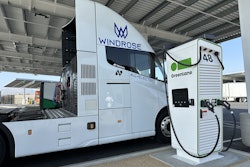
- Tesla Semi deployments at Zeem Solutions, powered by ABB-E mobility fast chargers, signal a tipping point for electric freight trucking
Electrified commercial trucking remains in a period of experimentation, where the industry is actively discovering which combinations of hardware, software, and infrastructure actually survive the rigors of the road.
Transitioning from diesel to electric is a steep learning curve, but Paul Gioupis, founder and CEO of Zeem Solutions, is navigating it by stripping away the complexity. Since 2017, Gioupis has championed a "Trucking-as-a-Service" (TaaS) business model that cuts "middleman" costs by bundling vehicles, charging, and maintenance into a single monthly fee.
[Related: Go inside America's busiest electric truck charging depot]
He argues that true future-proofing requires more than just fast charging; it demands modular, above-ground infrastructure—like the proprietary Zeem Kit—and oversized 4-inch conduits that can handle the massive power requirements of megawatt chargers.
 The Zeem Solutions Charging Kit package.Zeem Solutions/ABB-E mobility
[Related: Megawatt charging explained: What it is and why it matters]
Beyond the hardware, Gioupis sees a fundamental shift in the market's gravity, he explained to Clean Trucking. While acknowledging that current government grants act as a vital bridge, he points to a growing "incentive gap" where truck subsidies are available (in some states) but the critical infrastructure funding needed to power them remains scarce. That imbalance, he argues, is forcing customers to judge zero-emission solutions less on policy promises and more on real-world economics.
As such, he believes the industry is reaching a tipping point where operational performance and bankability will finally outpace the need for public support.
"Our customers don't care about politics. They care about reliability. It's got to make financial sense."
Finding financial success
Many U.S. fleets and owner-operators remain cautious about electrification, choosing instead to extend diesel operations with late-model Class 8 trucks, aerodynamic upgrades, and idle-reduction technologies. Gioupis, however, believes that hesitation is nearing an inflection point.
"We need to be able to diagnose vehicle and infrastructure and fleet management," he said. "Drayage is not the target. It's a crap market. Think regional hauling and who's bankable. If you can nail that market you're good. That's why we haven't seen the EV truck market take off. Previously, I wouldn't underwrite this but now I will—with my own cash."
Some developments, he says, that are driving that confidence include access to the right chargers—sourced, in this case, from ABB E-mobility—and the Tesla Semi, which is expected to enter series production this year.
[Related: ABB E-mobility's megawatt charging system previews the future of trucking]
"Fleets are still doubting the Tesla for whatever reasons," he added, but not Zeem.
The company's hands-on experience with early-build Tesla Semis has only reinforced Gioupis' outlook, particularly as the industry edges closer to autonomy.
"Regional hauling of at least 200 miles is when you start making money, at least with the Tesla. And with the right infrastructure price you don't need incentives. Zeem will finance that. You finally hit that mark," he said.
The game-changing Tesla Semi
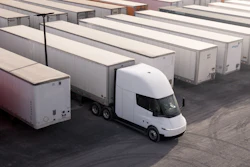
Having the right vehicle is critical for zero-emissions commercial road transport to work, and Gioupis, based on his experiences so far, is convinced the Tesla Semi "is going to change trucking forever.
"I will put my name all over the Tesla," he continued. "We're operating them right now and feel really good about them, as do our customers. The Semi continues to crush it on demos."
Tesla, according to Gioupis, is now exerting pressure not only on rival truck OEMs, but increasingly on charging OEMs as well, and that's where ABB-E mobility enters the scene.
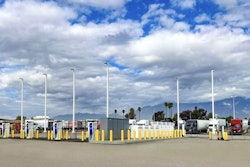
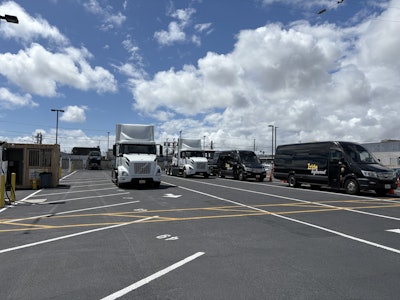
Zeem's LAX depot is supported by more than 75 of ABB's fast chargers, energized through a 7.5-MW grid interconnection. The depot operates under a shared-charging model, managing access to optimize charger utilization and overall throughput.
This setup is already proving to be successful.
 Zeem Solutions' Charging Kit package with an added mobile battery.Zeem Solutions/ABB-E mobility
In the first three quarters of 2025, Zeem confirms, the site delivered more than 2,400 MWh of energy, achieving a utilization rate nearly 50% higher than the U.S. public charging average. Despite accounting for only one-fifth of total charging sessions, medium- and heavy-duty vehicles consumed five times more energy than other users, underscoring the depot's focus on high-throughput commercial operations.
ABB-E mobility's critical role
ABB E-mobility plays a behind-the-scenes but essential role in keeping Zeem's LAX depot running at peak efficiency.
Around-the-clock remote monitoring, real-time diagnostics, and a steady supply of spare parts help ensure chargers stay online and keep vehicles moving. Regular maintenance is built into daily operations. Zeem's on-site coordinators are fully trained and certified on ABB's equipment, allowing them to collaborate closely with ABB specialists and resolve issues early—often before drivers ever notice a problem.
This success has led for the depot to serve fleets from rideshare vehicles to Class 8 trucks, with strong light-duty utilization helping to pave the way for heavy-duty electrification. In the first three quarters of 2025 alone, for instance, the site delivered over 60,000 charging sessions.
"At the end of the day, fleets are saying our product's flat pricing gives them significant confidence as operators," explains Gioupis.
He believes battery-electric trucks will last at least 10 years, including their batteries, and is working to educate fleets over time. Rather than focusing on specific vehicle brands, fleets are buying a full-service experience—one where performance matters most and Zeem even handles vehicle pickup as part of the offering.
That long-term mindset shapes how Zeem approaches risk, operations, and knowledge-sharing as fleets continue to scale their electrification strategies.
"Be mindful today of what could go wrong," Giuopis advises fleets. "Think about putting a set of procedures in place. For us, we ask ourselves 'how do we export our knowledge to your site?' That's the future of Zeem Solutions and the industry."