What you need to know:
- Ample filed for Chapter 11 bankruptcy on December 16 as the battery-swapping startup seeks to sell the business or restructure amid severe cash shortages and operational shutdowns.
- Despite raising more than $330 million in venture funding, the company reports $10–$50 million in assets versus $50–$100 million in liabilities, supported by a $6 million bankruptcy loan from Twelve Bridge Capital.
- Slowing renewable energy investment, rising supply chain costs, and broader EV market pressures undermined Ample’s modular battery swapping systems and charging infrastructure rollout.
- Ample’s battery-swapping pilot in Tokyo with Mitsubishi Motors, MFTBC, and Yamato Transport, focused on last-mile electric delivery vehicles, now faces uncertainty following the bankruptcy filing.
Another once-promising startup in the battery-electric vehicle (BEV) charging industry bites the dust.
San Francisco-based Ample, a manufacturer and developer of fully automated, modular battery swapping systems and charging infrastructure, filed for Chapter 11 bankruptcy on December 16 in the U.S. Bankruptcy Court for the Southern District of Texas.
The bankruptcy filing is intended to help the company sell its business or restructure its finances. Ongoing cash shortages, according to the press release, forced the company to shut down most operations and cut its staff down to just two employees.
Although Ample raised more than $330 million over its 11-year lifetime, it struggled as investment in renewable energy slowed and supply chain problems continued to increase costs. To keep the bankruptcy process moving, the company secured a $6 million loan from Twelve Bridge Capital, LLC to pay expenses during the bankruptcy case.
Ample estimates it currently has between $10 million and $50 million in assets, while its debts total between $50 million and $100 million. The filing states that some money is expected to be available to repay unsecured creditors.
Battery swapping in Tokyo?
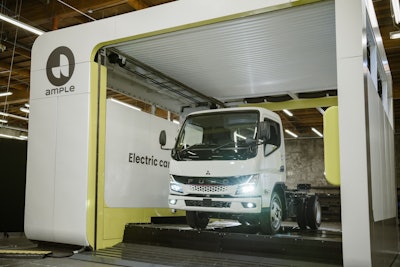
Last summer, Japanese manufacturer Mitsubishi Motors and Mitsubishi Fuso Truck and Bus Corporation (MFTBC), together with Yamato Transport teamed up with Ample for a new pilot project in Tokyo. At the time, the project called for the deployment of over 150 battery-swappable commercial electric vehicles and 14 modular battery swapping stations placed in strategic locations across Tokyo beginning last September.
The consortium, at the time, pointed out that a typical battery-electric light-duty truck requires about 10 hours with AC charging and a few hours with DC charging. But with battery swapping—still in use in parts of China—replacing a depleted battery with a fully charged one takes about five minutes.
The project aimed to deploy MFTBC's eCanter light-duty truck and Mitsubishi's Minicab EV in commercial delivery fleets. Yamato Transport is slated to be the first major customer, focusing on last-mile delivery operations. Ample was tasked with supplying its modular battery-swapping technology and management of the installation and operation of the swapping stations.
Clean Trucking has reached out to these companies seeking an update on the project's status given Ample's bankruptcy. We'll update this article if a response is received.