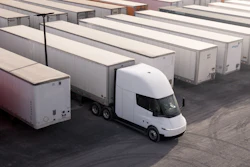














Following multiple delays, 2026 is shaping up to be the year of the Tesla Semi (probably).
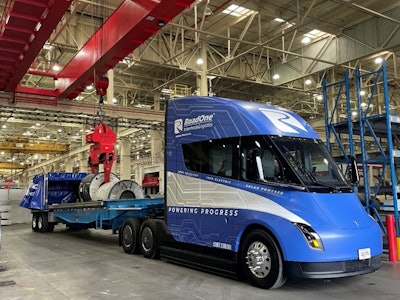
Randolph, Mass.-based RoadOne IntermodaLogistics has just announced the expansion of its existing partnership with Tesla with the addition of a Tesla Semi to its fleet. This purchase represents the first of up to ten electric semis planned for deployment in the Oakland, Calif. market.
This is not the logistics services and drayage provider's first time working directly with Tesla. The company's relationship dates back to 2012 when it began supporting shipments of aluminum coils to the OEM's Fremont stamping facility. By 2014, the relationship expanded into a just-in-time storage and delivery program that has grown significantly over time.
Fast forward to today as RoadOne now manages onsite inventories of aluminum and steel coils and provides continuous, multi-shift deliveries to keep Tesla’s stamping operations running smoothly.
"We are thrilled to welcome the first of what could be up to ten fully-electric semi-trucks into our fleet," said Eric Weakley, senior vice president of operations, RoadOne IntermodaLogistics. "This investment reflects our commitment to efficient, environmentally responsible logistics solutions. By offering a sustainable, low-emissions option we’re not only strengthening our service, but also contributing to a cleaner and more resilient supply chain."
RoadOne confirms its Tesla Semi has been in active service for several months and has exceeded performance expectations, echoing the experience of DHL, which took delivery of its first Tesla Semi last month after completing a successful pilot program.
[Related: DHL declares: 'Tesla Semi is ready for prime time']
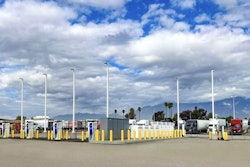
To recap, the Tesla Semi reportedly has the capability to deliver up to 500 miles of range and real-world efficiency of 1.9 kWh per mile while hauling average payloads of 38,000 pounds. Tesla engineers recently released a brief video showcasing the Semi's impressive Megawatt charging speed of 1.2 MW (1,206 kW), though the demonstration was done using the company's V4 Superchargers, which aren't the same as Megawatt chargers.
The former are the next-generation stalls for passenger vehicles that are capable of supporting up to 500 kW and 1,000V systems for faster charging. Megawatt chargers, on the other hand, can deliver over 1 MW, specifically for the Tesla Semi and other large Class 8 rigs.