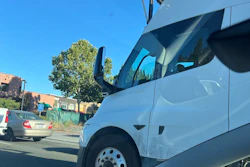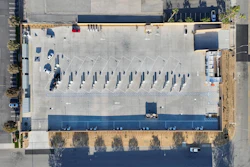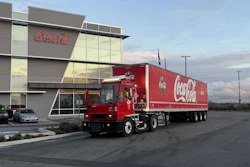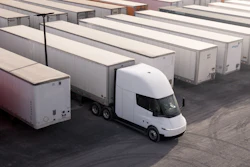














Earlier this week, we reported that a Tesla Semi was spotted in California equipped with full self-driving (FSD) hardware during road testing.
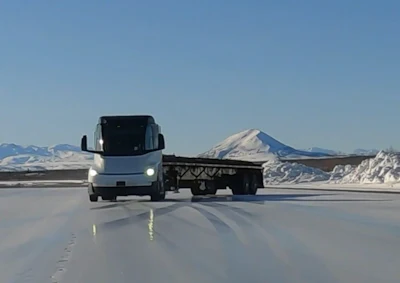
Today, Tesla Semi program manager Dan Priestley shared footage on X showing the all-electric Class 8 truck maintaining stability on a snow- and ice-covered road, demonstrating controlled handling in slippery conditions.
The video highlights the Tesla Semi's Vehicle Dynamics Control (VDC) system, illustrating how the electric powertrain can quickly modulate torque to maintain stability before a loss of control develops.
"Let's talk Vehicle Dynamics Control (VDC). With high resolution sensing and precise multi-motor controls developed in-house, the Tesla Semi provides torque and stability even on the trickiest of winter surfaces," Priestley wrote.
The footage shows the Tesla Semi briefly sliding on the ice before its stability systems restore control with minimal driver correction.
According to Tesla, VDC is "an in-house software system that manages a vehicle's stability, traction, and handling by integrating motor torque, braking, steering, and suspension. It provides millisecond-level adjustments, allowing the car to maintain control in severe weather or maximize agility on a racetrack."
The system, essentially, continuously interprets the driver's steering, throttle, and braking commands, then makes real-time adjustments to help the vehicle follow the intended path and maintain stability. In other words, VDC helps prevent the truck from jackknifing, which occurs when a tractor-trailer loses stability and the trailer swings out of alignment with the cab, causing the vehicle to fold into a sharp angle that can block multiple lanes of traffic.
Tesla Semi begins production
In April, Tesla announced that the first production-spec Semi had come off the line at its newly completed 1.7-million-square-foot Nevada factory, a site dedicated exclusively to building the electric truck. The facility is designed for up to 50,000 units annually, though production is expected to ramp gradually over time.
[Related: A quick tour of Tesla's long-awaited Semi]
Tesla plans to offer the Semi in two configurations: a Standard Range version with roughly 325 miles of range and a Long Range model capable of about 500 miles. Both variants are designed for an 82,000-pound gross combination weight and use a tri-motor electric drivetrain rated at up to 800 kW.
The company also claims the Semi consumes around 1.7 kWh per mile and is compatible with its Megawatt Charging System (MCS 3.2), which supports charging speeds of up to 1.2 MW. Tesla says the truck can regain roughly 60% of its battery capacity in about 30 minutes, which will make it suitable for long-haul use.
Tesla has not officially confirmed pricing, but is reportedly targeting about $290,000 for the Long Range version and roughly $260,000 for the Standard Range model.