









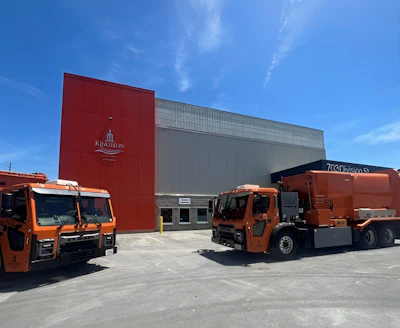
Battery-electric garbage trucks are continuing to prove themselves as smart and cleaner alternatives to not only their diesel-powered counterparts, but also CNG-fueled models as well.
We've seen this first-hand with our exclusive ride along last year in Louisville, Colorado, and now another North American city has made the jump to electrification.
[Related: Colorado city launches country's first EV garbage and recycling truck fleet]
Kingston, Ontario, which has set a goal of becoming Canada's "Most Sustainable City," has added two Mack LR Electric refuse trucks to its Solid Waste fleet, becoming the first municipality in Ontario to deploy battery-electric refuse trucks. The purchase received support by a $500,000 investment through the Federation of Canadian Municipalities' Green Municipal Fund and advances the city's target of reducing greenhouse gas emissions by 30% by 2030, while contributing to Canada's larger goal of achieving net-zero emissions by 2050.
"One of the city's strategic priorities is leading environmental stewardship and climate action, and purchasing these Mack LR Electric trucks is one of the ways we are working toward the achievement of these goals," said Brent Fowler, the city's director of corporate asset management and fleet.
[Related: Emterra Environmental's Mack LR Electrics hit the streets]
The vehicles entered service back in July 2025, coinciding with the city's launch of its new automated cart-based waste collection program. They have already proven to be up to the task.
"These vehicles have been in service for nearly a year, operating five days a week," said Karen Santucci, director of public works and solid waste for Kingston. "Their performance is top-notch, and the reception from both the public and our Solid Waste operators have been overwhelmingly positive."
The Mack LR Electric side-loading refuse trucks were supplied by Mack dealer Surgenor Truck Group, which also provides ongoing service and support. The trucks are equipped with refuse collection bodies manufactured by LaBrie Environmental Group.
The latest-generation Mack LR Electric refuse truck features a 376-kWh battery system, providing 42% more onboard energy and a longer operating range between charges than the previous model. The Class 8 truck is powered by twin electric motors that deliver 448 continuous horsepower and up to 4,051 lb.-ft. of peak torque, available instantly from zero rpm.
Power comes courtesy of four nickel manganese cobalt (NMC) lithium-ion battery packs that can be recharged using a 150-kW SAE J1772-compliant charging system. A two-stage regenerative braking system captures energy during the frequent stop-and-go operation typical of residential waste collection routes, helping improve efficiency throughout the workday.