













What you need to know:
- Daimler Truck and KEYOU plan to launch hydrogen combustion trucks in 2027 using existing Mercedes-Benz truck platforms
- The companies are developing hydrogen internal combustion engine trucks for heavy-duty and long-haul freight applications
- The trucks will use converted diesel engine technology, allowing fleets to benefit from familiar vehicle designs and service networks
- The partnership expands options for truck decarbonization, alongside battery-electric trucks and hydrogen fuel cell vehicles
The race is on in Europe to bring heavy-duty hydrogen combustion trucks to market.
And now, Daimler Truck and German hydrogen engine specialist KEYOU have announced the signing of an agreement to bring hydrogen internal combustion engine trucks to market, targeting commercial deployment beginning in 2027.
The OEM clarified to Clean Trucking that "the EU is the key target region for this partnership. Currently the regulatory environment in Germany is the most favorable, due to toll exemptions and a funding call for hydrogen refueling infrastructure by the German Federal Ministry of Transport. At the same time, KEYOU is already actively marketing the vehicles in the Netherlands, Belgium, and the Scandinavian region."
[Related: Despite Trump-era policies, hydrogen industry regroups and bets on heavy-duty growth]
The partnership will focus on adapting Daimler Truck's existing heavy-duty truck platforms and engine technology to run on hydrogen, offering fleets another zero-tailpipe-CO2 option alongside battery-electric and fuel cell vehicles.
"The road freight transport sector requires different drive solutions for different applications. Hydrogen can be used to power both fuel cells and internal combustion engines," said Andreas Gorbach, member of Daimler Truck's Board of Management responsible for Truck Technology. "By working with KEYOU, we are partnering with a specialized company to bring hydrogen combustion technology to market quickly and efficiently."
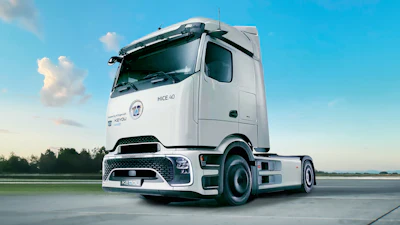
Under the agreement, Daimler Truck plans to supply Mercedes-Benz Actros L 1848 tractor units and engines based on its existing 12.8-liter platform. KEYOU will convert the diesel engines to operate on hydrogen using its proprietary "KEYOU-inside" technology, while external partners will handle vehicle integration.
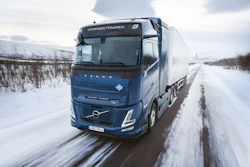
 Daimler Trucks' 12.8-liter platform converted to operate on hydrogen using proprietary "KEYOU-inside" technology.Daimler Trucks
The resulting vehicle, branded as the KEYOU HICE.40, is designed for 40-ton gross vehicle weight applications. According to the companies, the truck is expected to deliver up to 350 kW of power and a driving range of as much as 650 kilometers (~403 miles) using 350-bar compressed hydrogen storage.
[Related: Hydrogen combustion could drive down hydrogen costs]
Rather than developing hydrogen combustion technology entirely in-house, Daimler is fully utilizing KEYOU's expertise in converting proven production engines for hydrogen use. The companies said the approach is intended to accelerate commercialization while reducing development complexity.
For fleets, hydrogen combustion engines could offer several advantages compared with fuel cell systems. The technology uses a conventional engine architecture, allowing manufacturers to leverage existing vehicle designs, production facilities, and service networks. The companies also highlighted the technology’s robustness, lower system complexity, and suitability for applications where payload capacity is critical.
"The partnership with Daimler Truck is an important step for us to bring our KEYOU-inside technology into industrial application," said Thomas Korn, CEO and co-founder of KEYOU. "Together, we can significantly accelerate the development and scaling of hydrogen-based drive solutions in the commercial vehicle sector and thus make a tangible contribution to decarbonizing heavy-duty transport."
[Related: Mahle CEO: "We will fail if we don't use blue hydrogen"]
KEYOU will market the completed trucks directly to customers and is expected to support efforts to expand hydrogen refueling availability. The companies also plan to explore how existing service and maintenance networks can support long-term vehicle uptime and fleet operations.
Daimler reiterates that it continues to pursue a multi-technology strategy for truck decarbonization, investing in battery-electric, fuel cell, and hydrogen combustion. While battery-electric trucks are expected to serve a large share of freight applications, the company still sees hydrogen-powered technologies as complementary options for demanding long-haul and high-utilization operations.