













What you need to know:
- ChargePoint launches Express Solo, the world's fastest standalone EV charger, expanding EV charging infrastructure and improving access in underserved areas
- Compact DC fast charger delivers high-power charging with 40% greater power density, ideal for urban and space-limited sites
- Supports up to four vehicles with simultaneous EV charging and dynamic power sharing up to 600 kW per port, increasing station efficiency
- New platform addresses grid constraints, speed, reliability, and cost while enabling bidirectional charging and NACS/CCS compatibility
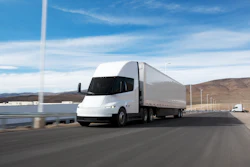
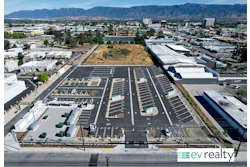
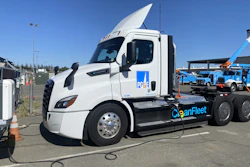
One of the biggest hurdles facing the deployment of battery-electric commercial and passenger vehicles alike is infrastructure, or the lack thereof in some parts of the country, especially rural areas.
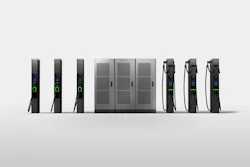
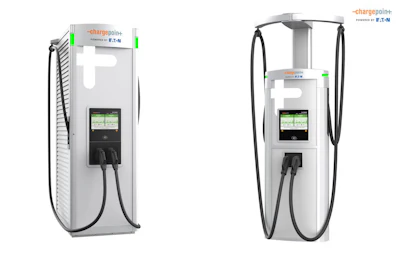
ChargePoint, one of the world's leading providers of charging solutions, has just unveiled the Solo Express, which the company claims to be the world's fastest standalone EV charger. It's also ChargePoint's first DC fast charger to be offered in Europe.
[Related: ChargePoint: new Megawatt Charging System will revolutionize commercial trucking]
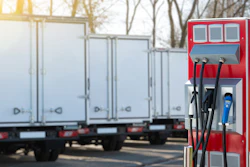
This new system is designed as a compact, all-in-one unit that delivers high-power charging while reducing the space and construction requirements typically associated with traditional installations.
By combining scalable performance within a single cabinet, the Express Solo charger enables deployment in locations where space is limited, such as urban fueling stations and convenience retail sites. The company says the charger achieves roughly 40% greater power density than comparable DC fast charging solutions, allowing operators to increase charging speeds without expanding their physical footprint.
The streamlined design is also intended to lower installation costs and simplify site planning, making it suitable both for immediate use and as a foundation for future network expansion.
[Related: ChargePoint's new Level 2 charger is a bargain for fleets]
Express Solo capabilities
Express Solo is designed to charge two electric vehicles at the same time and can be paired with an additional dispenser to support up to four vehicles per system. The charger dynamically distributes power across connected vehicles, delivering flexible output configurations of up to 600 kW per port—an approach the company describes as an industry-first.
The company says this capability allows site operators to increase the number of available fast-charging ports without significantly expanding infrastructure, helping reduce wait times for drivers while creating greater revenue potential for charging station owners.
Like most modern systems, the Express Solo is capable of charging two electric vehicles at once and can be paired with an additional dispenser to expand capacity to as many as four vehicles. Its architecture allows power to be distributed dynamically across multiple sessions, with output configurations reaching up to 600 kW per port—an approach positioned as a first for the industry.
Four challenges addressed
ChargePoint says its new Express platform, introduced with the Express Solo, is designed to tackle four key barriers to scaling DC fast charging, specifically: grid limitations, charging speed, system reliability, and overall cost.
The company plans to expand the architecture with additional DC charging solutions aimed at addressing these challenges across a range of deployment scenarios.
According to ChargePoint, the systems are engineered to deliver higher power output within a smaller physical footprint while supporting bidirectional charging and integration with energy storage. The platform is also intended to reduce installation and operating costs, while maintaining consistent performance for drivers. Compatibility across both NACS and CCS connector standards is enabled through the company's Omni Port system, allowing a single charger to serve a broader range of electric vehicles.
"The Express DC fast charging architecture delivers differentiation. Not just by higher output, but by how economically, efficiently, and flexibly that power is delivered. Express Solo combines unmatched power density, direct DC power input capabilities for solar integration and battery storage, and a modular architecture that scales with minimal cost and complexity. Collectively this redefines DC fast charging from a fixed asset into a future-ready energy platform," said Rick Wilmer, CEO at ChargePoint.
"For those with plans for expansion, Express Solo enables scalable configurations for any charging scenario, futureproofing a station owner’s investment by giving drivers an ideal fast charging experience today while offering flexibility for the EVs of tomorrow."