












Article Summary
California invested a record $383 million in zero-emission freight projects at the Port of Long Beach, including battery-electric cargo equipment, charging infrastructure, and expanded rail capacity that are expected to reduce port-related carbon dioxide emissions by over 12 percent and create more than 22,000 jobs by 2028.
- $383 million grant from California's Port and Freight Infrastructure Program (PFIP) funds zero-emission freight projects at Port of Long Beach
- 22,000+ jobs expected to be supported while reducing annual CO2 emissions by 12% and nitrogen oxide emissions by 5% by 2028
- 21% of Long Beach's cargo-handling fleet is now zero-emission, one of the highest adoption rates among U.S. seaports
- 15 battery-electric yard tractors deployed at SSA Terminals' Pier C, with nine additional top handlers and 61 more zero-emission machines planned
- $158 million rail facility investment shifts container traffic from trucks to rail, reducing congestion and emissions
The Port of Long Beach has announced it is moving forward with a series of zero-emission freight projects backed by a record $383 million grant from California's Port and Freight Infrastructure Program (PFIP), including new battery-electric cargo equipment, charging infrastructure, and expanded rail capacity designed to improve cargo efficiency while reducing emissions.
[Related: Port of Long Beach proposes 70-megawatt battery energy storage system]
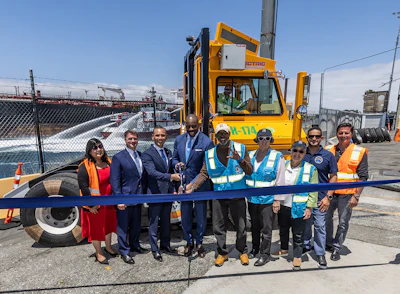
California State Transportation Agency (CalSTA) Secretary Toks Omishakin visited the port's Pier C terminal earlier this week to highlight progress on the state's largest PFIP award. The funding supports the Port's System-Wide Investment in Freight Transport (SWIFT) program, which finances terminal electrification, cleaner harbor vessels and rail improvements across the nation's second-busiest container port.
At SSA Terminals' Pier C facility, officials showcased 15 battery-electric, human-operated yard tractors built by Orange EV, along with associated charging infrastructure and a harbor tug repowered with a lower-emission engine. The terminal is operated by SSA Terminals, a joint venture between SSA Marine and Matson.
[Related: Inside Lazer Logistics' data-proven EV strategy for yard management]
The $383 million grant, awarded in 2023 as part of California's $1.3 billion PFIP initiative, also includes more than $158 million for the Port's Pier B On-Dock Rail Support Facility. The rail project is expected to shift more container traffic from trucks to rail, increasing cargo throughput while helping reduce congestion and emissions.
According to the Port of Long Beach, the combined projects are expected to support more than 22,000 jobs and cut annual port-related carbon dioxide emissions by more than 12% and nitrogen oxide emissions by more than 5% by 2028.
More than $200 million of the PFIP funding is being directed toward zero-emission cargo-handling equipment, charging infrastructure, shore power expansion and cleaner harbor craft through the SWIFT program.
The electric yard tractors at Pier C are part of a $37.8 million equipment project. Next year, SSA Terminals plans to deploy nine battery-electric top handlers and additional charging infrastructure under a separate $28.8 million investment.
The Port said maintaining human-operated equipment remains a key component of its transition strategy. Representatives from International Longshore and Warehouse Union Locals 13, 63 and 94 joined state and port officials during the equipment rollout.
The electrification effort continues to expand beyond Pier C. Last week, the Long Beach Board of Harbor Commissioners approved an additional $58.2 million in SWIFT funding for new zero-emission equipment and supporting infrastructure.
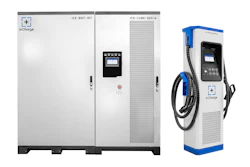
This latest funding package will finance 61 additional zero-emission cargo-handling machines, 21 charging units, six zero-emission harbor craft, five cleaner harbor vessels that will replace older diesel-powered equipment and development of a zero-emission locomotive.
Port officials said approximately 21% of Long Beach's cargo-handling fleet is now zero-emission, one of the highest adoption rates among U.S. seaports.
State officials said the investments are intended to strengthen California's freight network while advancing emissions reduction goals established following the supply chain disruptions experienced during the pandemic. For the Port of Long Beach, the projects represent another step toward modernizing terminal operations through equipment electrification, expanded rail capacity and infrastructure upgrades intended to support future cargo growth without increasing emissions.