













What you need to know:
- Humble unveils a fully autonomous, cabless, battery-electric truck targeting long-haul freight efficiency and lower operating costs
- Startup secures $24 million seed funding led by Eclipse Ventures with support from Energy Impact Partners to advance autonomous trucking
- Purpose-built alternative to Class 8 trucks delivers high utilization, energy efficiency, and improved total cost of ownership (TCO)
- Emphasis on autonomous safety, scalable fleet deployment, and flexible configurations for diverse freight applications
San Francisco-based Humble is entering the commercial freight market with a clean-sheet vehicle platform aimed at reducing operating costs and removing the driver from long-haul logistics.
Today, the startup announced it has emerged from stealth with a fully autonomous, cabless, battery-electric hauler that's purpose-built for high-utilization freight applications. The company says the platform is designed to eliminate traditional driver-related constraints while optimizing energy efficiency, maintenance, and lifecycle cost.
Alongside the reveal, Humble disclosed $24 million in seed funding. The round was led by Eclipse Ventures, with participation from Energy Impact Partners and additional investors.
[Related: Autonomous EV truck startup Einride going public via $1.8B SPAC deal]
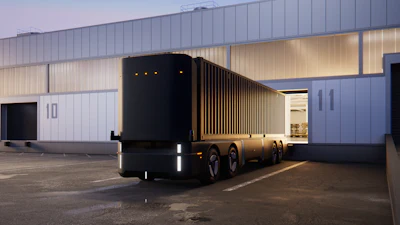
Humble is positioning its vehicle as a purpose-built alternative to conventional Class 8 trucks, removing the cab entirely to prioritize cargo capacity and system efficiency. The company indicates the design leverages autonomy from the ground up, rather than retrofitting driverless technology onto existing vehicle architectures. This strategy could reduce both hardware complexity and operating costs.
 A side view of the fully autonomous, cabless, and battery-electric Humble Class 8 semi.Humble
The announcement comes as fleets continue to evaluate automation and electrification not as standalone innovations, but rather as integrated pathways to improve total cost of ownership. By combining autonomy with a fully battery-electric platform, Humble specifies it's targeting use cases where predictable routes, high asset utilization, and energy cost control are critical.
[Related: Sales prospects for zero emission trucks dim but autonomous tech shines]
"I have dedicated my career to building electric and autonomous vehicle technology," said Eyal Cohen, Humble's founder and CEO, whose career includes stints at Apple, Uber, and Waabi. "For the first time, freight can be fully automated all the way to the loading dock. We are making freight sustainable, safe and efficient in a way no one thought was possible. And we're doing it with an exceptional team of industry veterans and AV experts — our first vehicle was completed in just six months."
While the company has not yet detailed deployment timelines or initial fleet partners, its approach reflects a broader industry shift toward purpose-built autonomous freight solutions designed for commercial scalability rather than pilot-stage testing.
 A rendering of Humble's fully autonomous, cabless, EV Class 8 semi driving on a highway.Humble
Humble is placing early emphasis on system safety and operational reliability as it advances its autonomous freight platform toward commercialization. The company adds that its autonomy stack incorporates multiple redundant safety layers, including proprietary guardrail systems designed to mitigate risk in dynamic, real-world freight environments.
As the company builds out its fleet, Humble plans to expand beyond a single vehicle format, developing configurable platforms tailored to a range of industrial and logistics use cases. That flexibility is expected to be key as fleets look for application-specific solutions that align with duty cycles, freight profiles, and infrastructure constraints.