













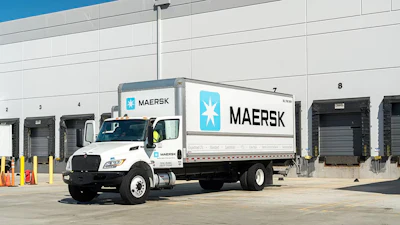
Maersk has announced the expansion of its North American logistics portfolio with the launch of a dedicated lithium-ion battery transportation service, providing manufacturers and suppliers a specialized ground freight solution for moving Class 9 batteries across the United States, Canada, and Mexico.
The new capability, part of Maersk Ground Freight, is designed to address increasing demand for compliant transportation as electric vehicle production, battery manufacturing, and energy storage investments continue to accelerate throughout the continent.
Industry analysts currently estimate the U.S. lithium-ion battery transportation market to be worth between $2.4 billion and $3.0 billion annually as a result of the ongoing expansion of domestic battery production and the broader clean energy supply chain.
[Related: Einride sues Maersk over scrapped 300-truck electric fleet deal]
Building infrastructure for the EV supply chain
As vehicle and battery manufacturers invest billions in new production facilities, logistics providers are expanding their capabilities to support the safe movement of hazardous battery shipments between factories, distribution centers, and assembly plants.
Lithium-ion batteries are regulated as Class 9 hazardous materials, which requires specialized handling, documentation, and transportation procedures. Maersk said its new ground freight service extends the company's existing dangerous goods expertise from ocean and air freight into over-the-road transportation, offering customers a more integrated logistics solution.
"The energy transition isn't just about what powers a vehicle—it's about the entire supply chain behind it," said Bob Livingston, U.S. head of Maersk Ground Freight operations. "Moving lithium batteries safely and at scale requires purpose-built logistics infrastructure, and that's exactly what we've created."
[Related: Coalition launches long-haul EV corridor along I-10]
Safety and compliance requirements
According to Maersk, the service is limited to new lithium-ion batteries and excludes damaged, defective, recalled, returned, or waste batteries.
To comply with transportation regulations, each shipment must include:
- A Safety Data Sheet (SDS)
- Dangerous Goods Declaration
- UN 38.3 Test Summary
- State-of-charge declaration
- Watt-hour rating documentation
The company also requires batteries to ship with a state of charge between 10% and 60%.
Maersk confirmed its ground freight network utilizes hazmat-trained drivers and supports cross-border shipments throughout the U.S., Canada, and Mexico while meeting each country's regulatory requirements.
Meeting logistics demand
The launch reflects a broader trend across the freight industry as logistics providers develop specialized services to support battery manufacturing and electrification. With dozens of battery plants, EV assembly facilities, and energy storage projects under development across North America, demand for compliant battery transportation is expected to continue growing over the coming years.
For commercial fleets, battery manufacturers, and automotive suppliers, expanded transportation options could help improve supply chain resilience while addressing the increasingly complex regulatory requirements associated with moving lithium-ion batteries.