













Article Summary
Electric yard tractors are moving from experimental pilots to mainstream fleet strategy, with WTC Group deploying Kalmar Ottawa T2 EV electric terminal tractors supported by Canadian government grant funding, while Kalmar expands its electric lineup with the 280 kWh Thunderbird model to meet growing customer demand for sustainable logistics.
- Fleet Shift: Electrification is transitioning from pilot programs to core fleet strategy in yard operations, with WTC Group leading adoption through Kalmar Ottawa T2 EV deployment.
- Increased Capacity: Kalmar's new Thunderbird tractor features 280 kilowatt-hours of battery capacity, a 70 kWh increase from previous models, enabling full six-plus hour shifts before charging.
- Cost Advantage: Early deployments show lower maintenance costs and zero diesel fuel expenses, though upfront costs remain roughly double comparable diesel tractors.
- Operator Familiarity: The T2 EV shares identical cab controls with diesel versions, eliminating retraining needs and reducing learning curves for operators switching between models.
- Grant Funding: WTC Group leverages Transport Canada's iMHZEV grant program to offset purchase costs, making electric adoption more accessible for smaller fleets.
Electrification is no longer a pilot-program curiosity in the yard. It's becoming a fleet strategy.
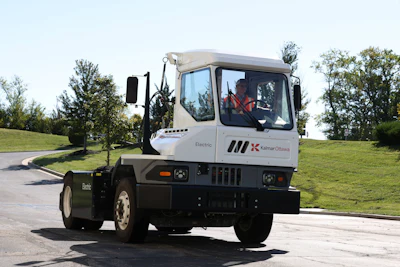
That shift is now display in a new deployment from WTC Group, a Canadian logistics and terminal services provider, which has placed an order for Kalmar Ottawa T2 EV electric terminal tractors, leaning on the iMHZEV (Incentives for Medium- and Heavy-Duty Zero-Emission Vehicles) grant program run by Transport Canada to fund the purchase.
"Innovation has always been central to WTC Group's operations," said Brad Gordon, the company's director of maintenance. As customer demand for sustainable logistics grows, he said, investing in electric terminal tractors is a natural next step.
A legacy brand's electric chapter
Kalmar Ottawa has spent nearly seven decades as the standard-bearer for diesel yard spotters—the terminal tractors, yard goats, and shunt trucks that keep distribution centers, ports, and intermodal yards moving, with the T2 diesel long serving as an industry benchmark for uptime and operator comfort.
The T2 EV carries that reputation into the battery-electric era, sharing cab controls with its diesel sibling so operators can move between the two without retraining. Kalmar calls it the most extensively tested product the company has ever brought to market. "Kalmar Ottawa has spent years developing the T2 EV to ensure when we came to the market with an EV yard spotter, we would have the best EV truck in the market," said James Leibold, zero emissions vehicle sales manager at Kalmar.
[Related: Go for a spin in Kalmar Ottawa's latest T2 EV yard tractor]
For WTC Group, early results are promising: operators cite smooth acceleration and a quieter cab, while fleet managers point to lower maintenance and no diesel fuel spend. Yard operations, once a logistics afterthought, are now prime territory for electrification—predictable duty cycles and proximity to charging make terminal tractors natural early adopters.
More power, faster than expected
The order lands just as Kalmar Ottawa expands what its electric lineup can do. In an interview with Clean Trucking at ACT Expo 2026, Eric Streich, Kalmar's North American sales manager for terminal tractors, detailed the company's newest addition: a higher-capacity electric tractor nicknamed "Thunderbird," also known as the "Super E."
The headline number is 280 kilowatt-hours of onboard energy—a 70 kWh jump over the 210 kWh tractor Kalmar was demoing a year earlier. Streich said the increase was a direct response to customer feedback.
"The market came back to us when we were demoing our 210-kilowatt-hour tractor last year and said, 'Can you add more energy?'"
The biggest pain point was opportunity charging at ports and terminals, particularly in rail applications—the most demanding duty cycle a yard tractor faces. The added capacity gets operators through a full shift, typically six-plus hours, before charging for eight to ten hours.
Packing more battery into a terminal tractor isn't as simple as bolting on bigger packs, Streich said. A tight turning radius is non-negotiable for yard operations, which limited how much room engineers had on the frame rails.
"Our engineers got creative," he said, describing a redesigned hydraulic tank that freed up space for two additional battery packs on the roadside frame rail, along with a reoriented low-voltage junction box and reworked battery management and thermal management software to support the added packs.
"Because we control the design right down to the component level, it was our engineers internally who made this happen," Streich said, adding the turnaround was fast by industry standards—if not fast enough for the sales team's liking. "We all would have liked it to have been quicker, of course. But that's the truck salesman's mentality."
What customers are saying
Beyond the request for more range, Streich said feedback has centered on serviceability and familiarity—customers call it the best-engineered truck they've seen, and appreciate how much carries over from the diesel T2, from parts commonality to a cab that feels and looks identical.
"Everything's the same," Streich said, pointing to the seating position, steering wheel, and dash. He recalled a demo delivery earlier this year, where an operator remarked the 280 kWh tractor felt just like his existing truck—a shortened learning curve that Streich said translates directly into productivity.
Making the business case
Kalmar is also leaning on data to help fleets pencil out the switch. For customers running Kalmar Insight, its proprietary telematics platform, the company can pull 12 months of duty-cycle data and model what an equivalent electric tractor would have cost to run over that period—energy consumed, estimated electricity costs, and projected maintenance savings—giving customers a total-cost-of-ownership picture before they commit.
Dealers also conduct on-site surveys to verify a fleet's actual duty cycle before quoting.
That business case matters, because the sticker price is still a hurdle. Streich estimated the T2 EV costs close to double a comparable diesel tractor, a gap that makes smaller fleets hesitant even when they like what they see.
Advice for fleets just getting started
With diesel costs weighing on budgets, Streich's advice for smaller operators starts with picking the right partner—one who can connect them with a charging infrastructure supplier for site surveys and installation planning, and help access state or federal grant funding to offset the upfront cost. "If we can get a customer a little bit of assistance, we can definitely transition them to this product," he said.
Kalmar Ottawa is also building toward over-the-air software updates, not yet active but on the roadmap. Recent software tuning alone—adjustments to ramp-up speeds and related parameters—has already yielded a 5 to 7 percent efficiency gain, a preview of what OTA updates could unlock. Kalmar's network of more than 170 dealer locations gives fleets access to factory-trained technicians for both the mechanical and software sides of the equipment.
The bigger picture
Taken together, the WTC Group deployment and Kalmar Ottawa's expanding electric lineup point to the same conclusion: electric yard tractors are moving past the demonstration phase.
WTC Group's grant-backed investment gives Kalmar Ottawa a proof point in a segment—ports and intermodal terminals—where reliability concerns have historically slowed EV adoption, while the rapid addition of a higher-capacity tractor shows a company iterating based on what fleets are telling it in the field.
"From diesel dominance to electric excellence, the journey continues—one yard goat at a time," Kalmar said. Based on the pace of change over the past year, that journey appears to be moving faster than expected.
[Related: Inside Lazer Logistics' data-proven EV strategy for yard management]