













What you need to know:
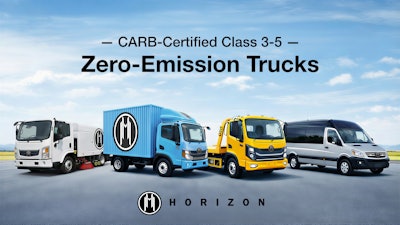
- Horizon Motor received CARB Executive Order certification for 2026 Class 3–5 zero-emission trucks meeting California heavy-duty emissions standards.
- The approval allows sales of battery-electric commercial vehicles in California and multiple CARB-adopting states.
- Horizon applied for California HVIP incentives under the Hybrid and Zero-Emission Truck and Bus Voucher Incentive Project.
- The company is advancing solid-state battery technology to expand its Class 3–8 electric truck portfolio.
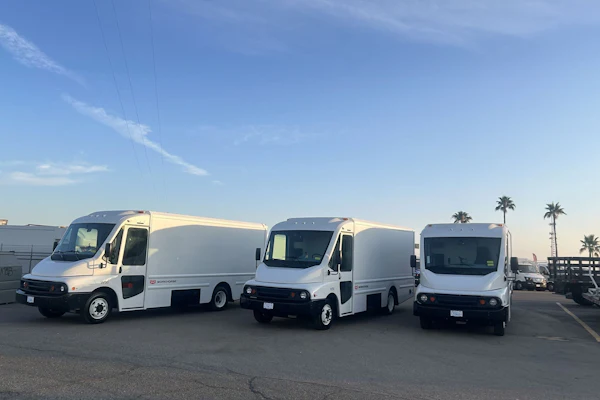
Horizon Motor, the Athens, Ohio-based manufacturer of zero-emission, battery-electric commercial vehicles, is back in the news because it has received California Air Resources Board (CARB) Executive Order certification for the 2026 model year of its Class 3-5 lineup.
[Related: Horizon Motor earns EPA certification for new battery-electric truck lineup]
This approval verifies that Horizon's all-electric powertrain platforms comply with the Golden State's strict regulatory framework for heavy-duty zero-emission systems starting with the 2021 model year, and officially recognizes them as producing no tailpipe pollutants or greenhouse gas emissions.
As such, the Executive Order permits Horizon to sell Class 3–5 zero-emission vehicles in California and in other states that have already adopted CARB heavy-duty emissions requirements, specifically Oregon, Washington, New York, New Jersey, Massachusetts, Vermont, Connecticut, Colorado, Maryland, Rhode Island, Maine, and New Mexico.
The manufacturer further confirmed it has submitted an application for participation in some key incentive programs, including California's Hybrid and Zero-Emission Truck and Bus Voucher Incentive Project (HVIP), and is awaiting the agency's determination.
In the weeks ahead, Horizon says it expects further CARB approvals for heavier vehicle classes, accelerating the expansion of its Class 3–8 zero-emission portfolio.
Horizon Motor and solid-state batteries
Late last year, Horizon made an equally important announced a new agreement with China's Chery Automotive to secure a supply of 1 gigawatt-hour (GWh) of solid-state batteries.
"This agreement represents a major step forward for Horizon and for the vocational EV industry," said Sean Jones, CEO of Horizon, at the time. "Securing access to solid-state battery technology positions us to scale production and deliver higher-performance electric trucks to fleets across the country."
Solid-state battery technology is broadly regarded as a significant evolution in electric vehicle energy storage, delivering greater energy density, enhanced safety characteristics, extended driving range, and the potential for longer operational life than conventional lithium-ion and LFP batteries.
[Related: Swappable batteries? Horizon Motors wants to make it happen]
Horizon's current truck models are designed with battery-swapping capability, though Jones suggested to Clean Trucking that feature may be phased out once solid-state battery technology is introduced. "I don't think we'll do swappable because it no longer makes sense. If you have the power there you can charge them in 10 minutes tops."