













What you need to know:
- Autonomous Defense Vehicles are the focus of Harbinger's new unmanned hybrid-electric platform, designed for logistics, troop transport, communications, security, and counter-drone operations
- Strategic Defense Technology Investment from In-Q-Tel (IQT) supports Harbinger's expansion into military mobility, autonomous systems, and national security markets
- Hybrid-Electric Military Mobility Platform capabilities include more than 500 miles of range, teleoperation, autonomous-ready architecture, and onboard power generation for mission-critical operations
- Next-Generation Uncrewed Ground Systems are a key growth area for Harbinger as it advances defense robotics initiatives and expands its partnership with American Rheinmetall
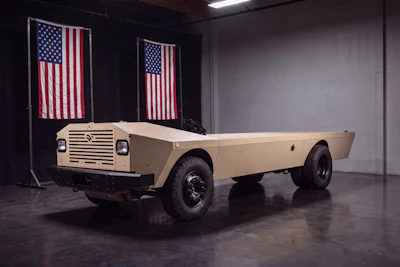
Garden Grove, California-based Harbinger unveiled today a new unmanned hybrid-electric vehicle platform aimed at defense and government customers, marking the expansion of the company's operations into military mobility and autonomous ground systems.
[Related: Harbinger sees unexpected EV sales surge after federal incentives expire]
The platform, launched under Harbinger's new defense division, Harbinger Praesidia, is being developed in collaboration with U.S. government agencies and defense contractors for applications including logistics support, troop transport, field communications, perimeter security and counter-drone operations.
The announcement coincides with a strategic investment from In-Q-Tel (IQT), a nonprofit investment organization that identifies and supports emerging technologies for the U.S. national security community and allied nations. Specific financial terms of the investment were not disclosed.
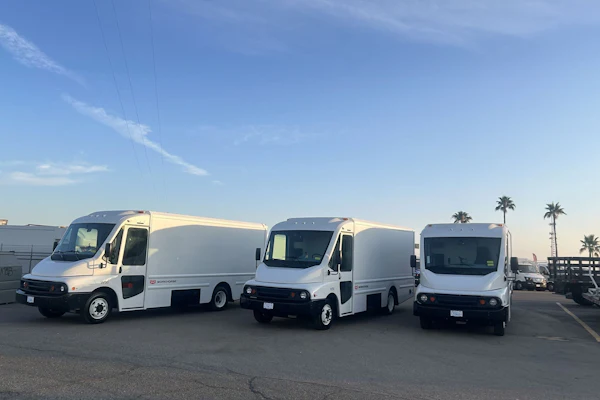
Harbinger's defense vehicles are based on the company's commercially deployed medium-duty plug-in hybrid chassis, enabling the manufacturer to leverage existing production capabilities while adapting the platform for military use. The vehicles are designed to support autonomous and remotely operated missions through proprietary software and drive-by-wire systems developed in-house.
[Related: Harbinger's new MD plug-in hybrid boasts a 500-mile range]
The platform is offered in three wheelbase configurations and supports gross vehicle weight ratings ranging from 16,000 to 26,000 pounds, with payload capacities of up to 18,000 pounds. Harbinger said the vehicles are intended for missions where power generation, payload capacity, operational range and remote operation are critical requirements.
The hybrid-electric architecture combines an electric drivetrain with a gasoline-powered generator, providing more than 500 miles of hybrid operating range and approximately 105 miles of all-electric range. The system can also serve as a mobile power source, exporting up to 350 kilowatts to support field equipment and mission systems.
Additional performance specifications include a top speed of 65 mph, a minimum turning radius of 21 feet and operation in temperatures ranging from -30°C to 55°C. The platform is also designed to function at altitudes up to 12,000 feet.
To support unmanned operations, the vehicles incorporate steer-by-wire, brake-by-wire and accelerator-by-wire technologies, along with system redundancies and a six-camera, 360-degree situational awareness system. Communications capabilities include integrated mesh radio networks for line-of-sight teleoperation and satellite connectivity for beyond-line-of-sight missions.
Harbinger said the platform includes mission-focused features such as silent electric operation, remote equipment actuation and dual-network communications. The vehicles are designed to operate across a variety of terrain and environmental conditions, including off-road environments and adverse weather.
The defense initiative builds on Harbinger's broader efforts to expand into military mobility and robotics. Late last month, the company announced a partnership with American Rheinmetall to develop next-generation robotic and uncrewed ground vehicles for defense applications.
"The government needs robust vehicles that can support a wide range of use cases without forcing operators to compromise on payload, range, exportable power or durability," said Harbinger Co-founder and CEO John Harris. "Our American designed, engineered and assembled vehicles fulfill this need while supporting domestic manufacturing capacity, which is itself a national security asset. At the same time, these unmanned vehicles are engineered to help keep soldiers out of harm’s way without compromising on performance."