













What you need to know:
- Ford Motor Company has formed Ford Energy to produce battery energy storage systems (BESS) in the U.S. for utilities, data centers, and industrial energy storage customers
- The company will convert its BlueOval SK plant in Glendale to build 5 MWh+ energy storage systems, including LFP prismatic cells, BESS modules, and containerized storage units
- The flagship Ford Energy DC Block uses 512 Ah lithium iron phosphate batteries and comes in two-hour FE-250 and four-hour FE-450 configurations with liquid cooling and integrated battery management
- Ford targets production within 18 months and more than 20 GWh annual capacity by 2027, while also moving into residential energy storage through BlueOval Battery Park Michigan under Lisa Drake
Ford Motor Company has launched a new wholly owned subsidiary, Ford Energy, to manufacture battery energy storage systems (BESS) in the U.S. for utilities, data centers, and large industrial and commercial customers.
The new business marks Ford's entry into the rapidly growing energy storage market, with an initial focus on utility-scale systems. The company also plans to expand into residential energy storage by supplying battery cells for home backup and energy management applications.
How does this impact commercial fleets? Ford Energy's main impact is indirect but strategic, as it strengthens the energy infrastructure that fleet electrification depends on.
[Related: Ford Pro releases smart charging bundle for California customers]
Made in Kentucky
As part of the initiative, Ford will repurpose its BlueOval SK facility in Glendale, Ky. to produce advanced battery energy storage systems with capacities of more than 5 MWh. The site will manufacture lithium iron phosphate (LFP) prismatic battery cells, BESS modules, and 20-foot direct-current containerized storage systems for commercial and utility-scale deployment.
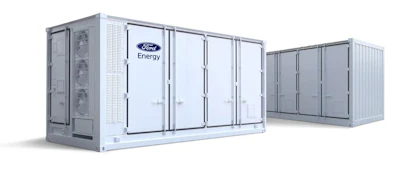
Ford's flagship product, the Ford Energy DC Block, is a standardized 20-foot containerized storage platform built around 512 Ah LFP prismatic cells. The system will be offered in two versions: the FE-250, designed for two-hour duration storage, and the FE-450, a four-hour configuration. Both systems feature liquid-cooled thermal management and integrated battery management technology.
The automaker said production is expected to begin within 18 months, with annual manufacturing capacity projected to surpass 20 GWh by 2027. Ford also plans to use its BlueOval Battery Park Michigan facility to manufacture smaller amp-hour cells for residential energy storage products.
According to the company, the new venture is designed to make use of underutilized electric vehicle battery manufacturing capacity while creating an additional long-term revenue stream in the energy storage sector.
Ford has appointed Lisa Drake as president of Ford Energy. She will report to John Lawler and previously served as Ford's vice president of Technology Platform Programs and EV Systems, overseeing the company’s battery strategy and electric propulsion engineering operations.