













What you need to know:
- Zeem Solutions CEO Paul Gioupis says 2026 marks a key commercial EV inflection point, with Tesla Semi fleets now competing directly with diesel economics
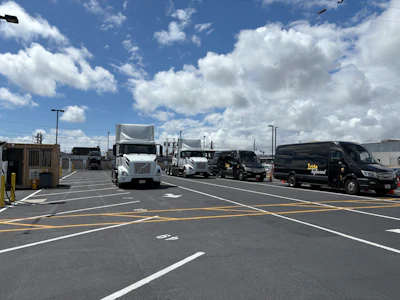
- The company's Long Beach EV depot already has 140 electric trucks contracted, signaling strong demand for zero-emission freight
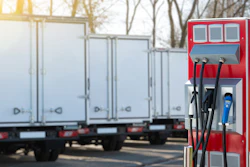
- Zeem is launching MyGrid, a mobile EV charging platform designed to speed up electric truck infrastructure deployment
- A new Newark, New Jersey hub will anchor Zeem's East Coast fleet electrification expansion
Commercial EV infrastructure provider Zeem Solutions says 2026 will mark a turning point for freight electrification, as the company accelerates depot deployments, launches a mobile power platform and expands its Trucking-as-a-Service (TaaS) model to the East Coast.
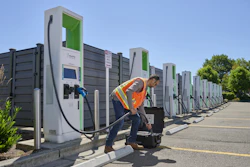
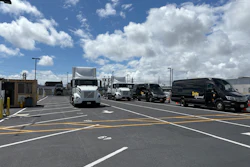
Clean Trucking spoke with Paul Gioupis, co-founder and CEO of Zeem Solutions, at the ACT Expo 2026 in Las Vegas, where he confirmed the company has overcome key permitting and utility hurdles at its flagship depot in Long Beach, California and expects the site to be fully energized by September, if not sooner.
[Related: Go inside America's busiest electric truck charging depot]
"So we finally got caught up on our Long Beach depot trying to get an easement signed and it looks like that finally has happened about three weeks ago," Gioupis said. "This is part of the problems and the landmines that occur in the EV industry."
Long Beach depot positioned for immediate demand
Despite the delays, Zeem expects the facility to generate immediate demand. Gioupis said 140 electric trucks are already contracted to operate from the Long Beach hub, supported by California's HVIP incentive program and a Port of Long Beach grant.
"What's interesting about Long Beach is we have 140 trucks that are contracted there," he said. "So what'll happen is a massive load right away. This site will be profitable right away as soon as it starts. Every single truck that's operating out of there is operating well below cost of a diesel."
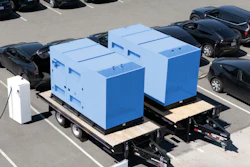
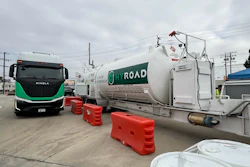
The Long Beach site is also becoming the launch point for Zeem's newest product, a mobile charging and energy platform called "MyGrid." Developed internally by Zeem and powered by battery systems from supplier CSI, the platform allows EV charging infrastructure to operate using either conventional grid connections or transportable battery power.
"The supplier is a group called CSI," Gioupis said. "They make the battery. The kit is a system that we developed called MyGrid. And what it does—it's taking this EV charging kit. It could be powered by the grid, which is what it’s meant to do, but it could also be powered by a mobile battery."
The technology will immediately address a familiar bottleneck in EV infrastructure deployment: utility interconnection delays. Although the Long Beach easement has been finalized, utility crews still require roughly two additional months to complete permanent powerline work. Zeem plans to bridge that gap with mobile batteries beginning the week of the 18th.
"So in Long Beach, I've been waiting for the interconnection," Gioupis said. "We finally got the easement signed, but it's going to take them two months to run the power lines to us. So we're going to power up on the week of the 18th using a mobile battery. This will be the first time that we’ll bring in power from the battery and it's going to light up the entire charging hub in Long Beach."
SeaTac expansion clears key regulatory hurdles
The company is pursuing a similar infrastructure strategy at its SeaTac-area depot near Seattle. After nearly a year of utility and zoning complications, Zeem recently secured commercial EV charging rights from the city, clearing a major development hurdle.
"The utility—we've had a lease there for almost a year—says, 'Oh, you're all good. You're going to be able to clear the way and get started,'" Gioupis said. "And then there's zoning issues that prevent us from moving forward."
Gioupis said the updated zoning framework also strengthens the site's future role in autonomous transportation.
"The city just gave us essentially EV charging rights for commercial, which is good," he said. "It sort of enhances the ability to bring in hopefully in the future autonomous vehicles, which is something that we're starting to do a lot more."
The SeaTac facility, backed by a major grant, is expected to open by the first quarter of 2027 or earlier.
Autonomous vehicle charging becomes growth segment
Autonomous fleet support is already becoming part of Zeem's operating portfolio. Gioupis said the company has been charging vehicles for an autonomous mobility customer for six to seven months while maintaining uptime above 98%, including more than 99% uptime for that specific client.
"We've been charging for an autonomous vehicle company now for about six or seven months," he said. “Enjoying significant uptime. We're up about 98-plus percent. In fact, for that particular customer, over 99% of the time."
Newark expansion anchors East Coast strategy
While Zeem continues expanding on the West Coast, the company is increasingly focused on the East Coast freight corridor. Newark, New Jersey, is set to become the company's next major hub and what Gioupis described as Zeem's new "ground zero."
"I came here to LA to really plant some seeds, to really understand it," he said. "Now I'm taking all what we've learned here, bringing it over to the East Coast. So we're absolutely bringing the business model super hard to the East Coast."
The Newark project will integrate directly with a power plant through a high-voltage, 110-megawatt transformer connection using a transmission tariff interconnection structure designed to reduce electricity pricing.
[Related: Megawatt charging explained: What it is and why it matters]
"The one that we have in Newark is going to be a transmission tariff interconnection, so a high-voltage interconnection," Gioupis said. "It's a 110-megawatt transformer and the interconnection—how we're connecting to it—is going to give us discounted pricing. So we’re going to be able to come in and really come well below the cost of diesel in that market."
Zeem also plans to move its MyGrid mobile battery operation from Long Beach to Newark as it scales mobile power services nationally.
"You're going to see that as our launching pad to fully drive the mobile business," Gioupis said.
Zeem sees EV economics reaching 'inflection point'
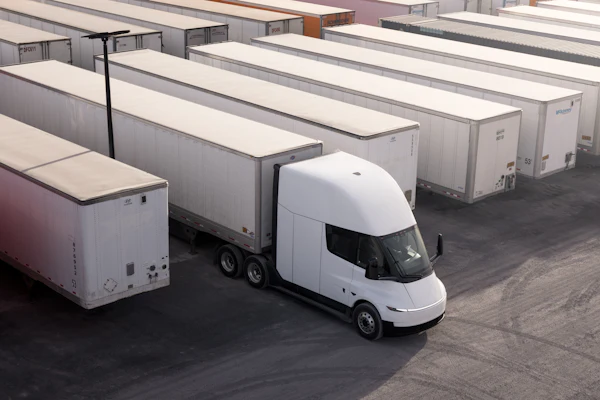
Gioupis argues the economics of commercial EV adoption are now reaching a self-sustaining threshold even as government subsidies begin to decline. According to Zeem, fleets operating 20 Tesla Semi long-range trucks at roughly 250 miles per day can already outperform diesel economics without incentives when paired with Zeem's charging infrastructure.
“Here's what I love. I think this year's a major inflection point," he said. "With 20 Tesla Semi long-range trucks, if you're running those at least 250 miles a day and you have 20 of them with our MyGrid charging kit, I don't need an incentive to make it pencil versus diesel."
[Related: Zeem Solutions CEO: 'Our customers care about reliability and financial sense, not politics']
Gioupis described the economics as rapidly improving beyond that threshold.
"So again, I'm at 20 trucks," he said. "What happens at 25, it starts to get really good. Now you get to 30, 40 trucks. It's exponential. So what's good is I've crossed that point. The 20-unit mark is that number."
At the same time, rising diesel costs continue reshaping fleet conversations. Gioupis said operators remain cautious about energy price volatility but increasingly see EV charging as a more stable long-term cost structure.
"What I end up telling the fleets is you have price certainty when it comes to EV," he said. "That's going to be the difference with diesel."
Fleet operators, he added, still worry about utility pricing fluctuations.
"The reality of that answer is yes, it could," Gioupis said when discussing possible utility-rate increases. "What do I do? How am I properly hedging? Is there a way I could lock it in? Those questions are coming in."
Tesla's commercial EV strategy pressures legacy OEMs
Gioupis believes the broader commercial EV market is also being reshaped by Tesla's aggressive infrastructure and vehicle pricing strategy, which he says legacy truck manufacturers have struggled to match.
"It's definitely well ahead of what everybody else has expected and we're incredibly pleased," he said of Tesla's commercial platform. "I'm willing to take that truck plus the infrastructure and fund it over five- and 10-year contracts all day long. Anything else, I'm not willing to."
[Related: Tesla Semi enters production at Nevada Gigafactory]
He was particularly critical of incumbent truck OEMs, arguing their U.S. electric truck programs have lagged behind their European counterparts.
"How come their trucks here are very different than what's in Europe?" Gioupis said. "We all know that they can make those investments and make them work. And I just think that nobody can compete with the type of technology advancement that Tesla has."
For Gioupis, the commercial freight transition is no longer theoretical.
"This year is the inflection point," he concluded. "Logistics will change forever, in my opinion, in 2026."